Readers researching hyper3d can use this independent comparison of Tripo AI and SupaVoxel to examine credit costs, price disclosure, and feature limits for a watch-stand generation.
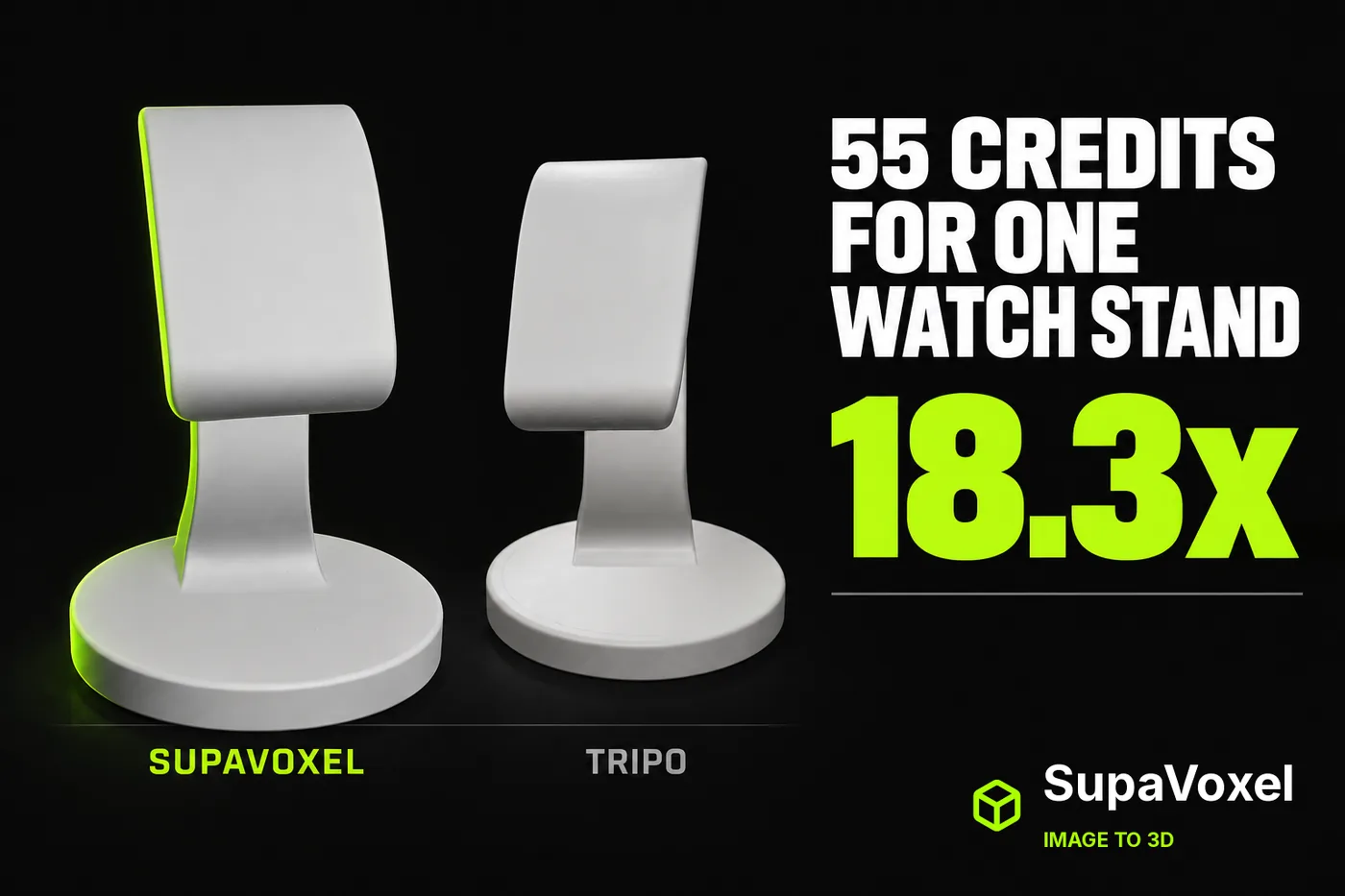
Independent review: both products were tested on my own accounts — free where offered and paid where not — with no vendor-provided access.
My verdict in 60 seconds — Tripo 60/100, SupaVoxel 90/100
One photo of a cantilever watch stand, one generation each, product defaults on both sides. Tripo took 55 credits for it. SupaVoxel took 3. I watched both balances move: Tripo 990 → 935 while the job was still spinning, SupaVoxel 358 → 355. That is 18.3× for the same object, and Tripo does not tell you the price until after you have uploaded your image.
- Credits for one model — Tripo 55 · SupaVoxel 3 · 18.3×
- Credits for a 100-piece batch — Tripo 5,500 · SupaVoxel 300 · 5,200 credits of difference
- Price visible before upload — Tripo no (a bare arrow) · SupaVoxel yes ("Generate (3 credits)")
- When you are charged — Tripo on submit (balance fell mid-generation) · SupaVoxel not captured
- Wall clock, this subject — Tripo 160.0 s · SupaVoxel 250.2 s · Tripo wins this one by 90 s (one of 3 subjects in 10)
- Usage-capped switches in the panel — Tripo 3 (Clean Topology ×2, Generate in Parts ×1, 8K Texture ×1) · SupaVoxel 0
- Hard feature locks — Tripo 2 marked Members Only · SupaVoxel 0 on the hobbyist tier
- CDN cost at 10k loads/month — Tripo $51.65 · SupaVoxel $6.55 · $45.10/month of difference
Five things about Tripo's meter:
- Tripo shows you a plain Generate arrow until your image is uploaded. Only then does the button read Generate 55.
- The toggle that decides whether your topology is clean is called Clean Topology, it is off by default, and it carries a Trial ×2 badge. You get two.
- Generate in Parts and 8K Texture sit behind Members Only plus Trial ×1 each. You pay 55 credits and part of the panel is still behind glass.
- Tripo won the clock on this subject by 90 seconds. Across all ten subjects SupaVoxel was the faster tool on seven of ten — but Tripo was the steadier one, finishing every subject inside a 54-second band. Both halves of that are below.
- Tripo takes its 55 credits once and no more — but the 60.77 MB file it hands back keeps costing you on your own bandwidth bill: $51.65 per 10,000 page loads against $6.55.
For volume work — a catalogue, a store, anything past a handful of pieces — SupaVoxel is the cheaper meter. If what you need is one model on a deadline and the credits do not matter, Tripo is the safer bet on time: not because it is quicker on average, but because it is the one that never surprised me.
The two studios, before anything is uploaded
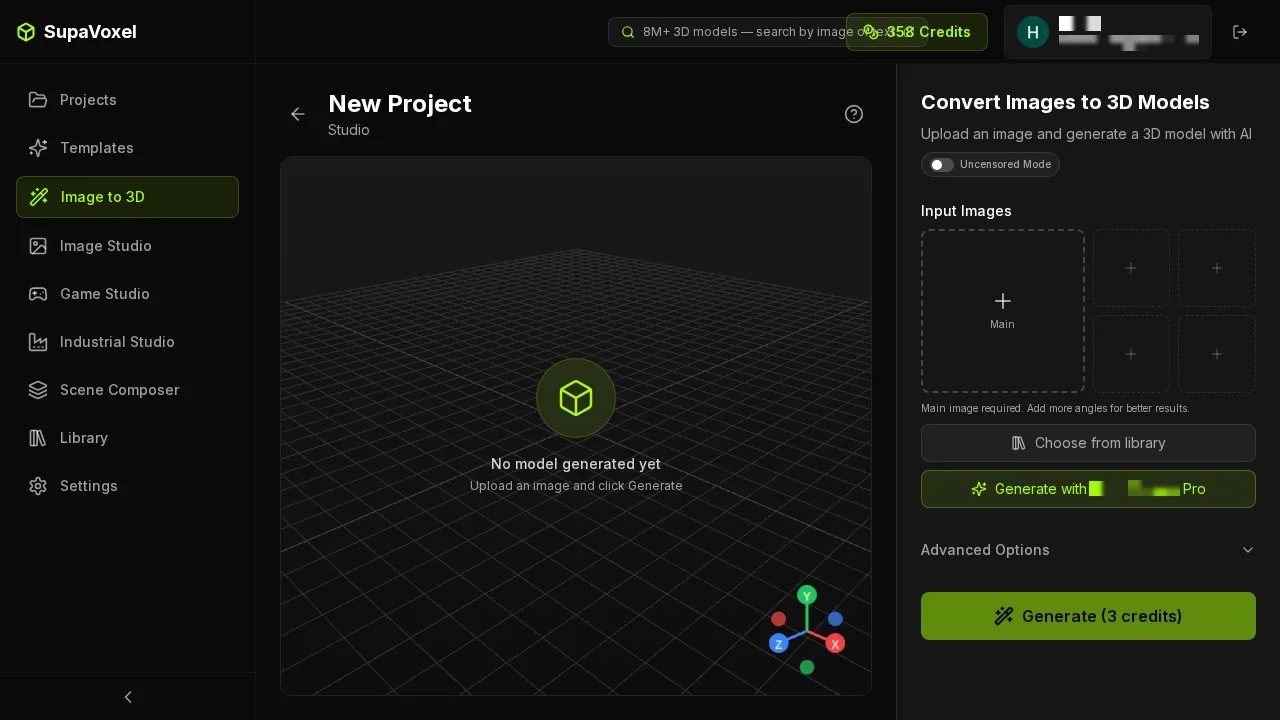
SupaVoxel's studio with an empty canvas: the button already reads "Generate (3 credits)". Five image slots — one Main plus four extra angles.

Tripo's studio at the same moment: two quality tiers, Best Quality selected and Clean Topology badged Trial ×2. Balance 990, an Upgrade button beside it, and a Generate control with no price on it.
You cannot compare prices in Tripo before committing an image, because there is no price on screen. SupaVoxel puts 3 credits on the button before the canvas has anything in it.
- Price shown pre-upload — Tripo none · SupaVoxel "Generate (3 credits)" · unchanged after upload
- Reference image slots — Tripo 1 · SupaVoxel 5 (1 Main + 4 angles) · this case used 1
Then the price appears: Generate 55
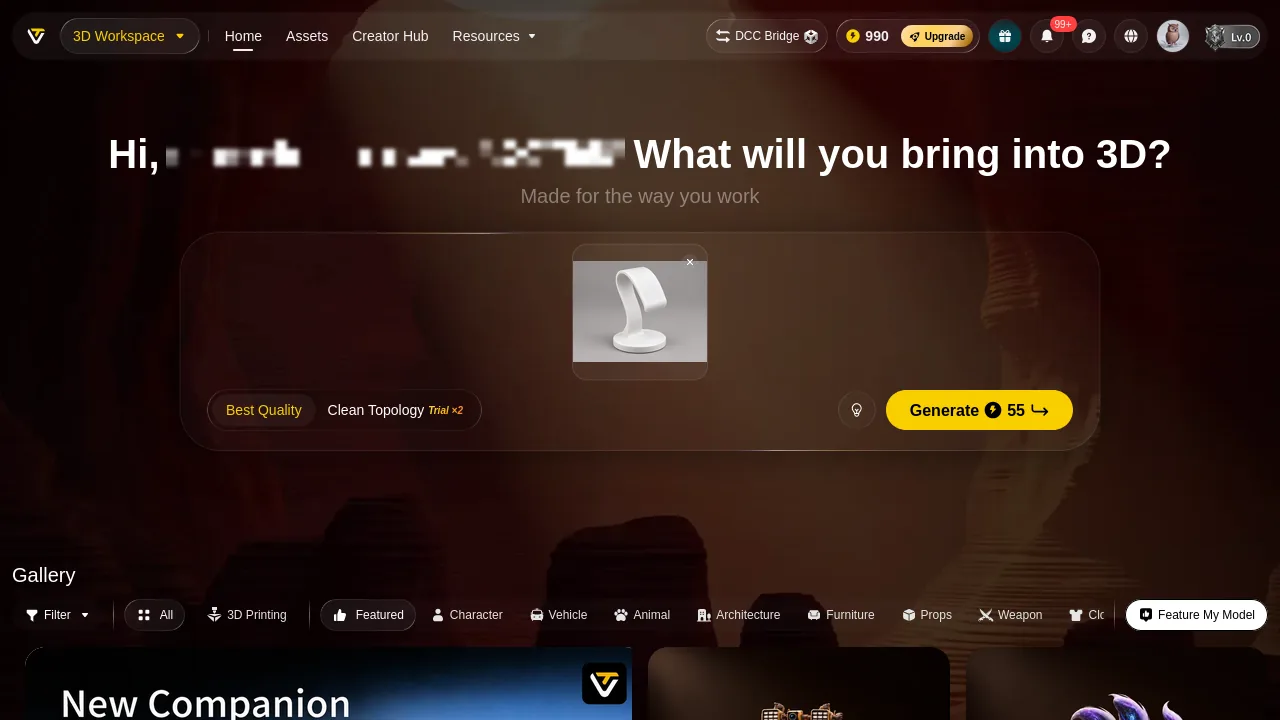
Image in, and Tripo's button now reads Generate 55. The Clean Topology Trial ×2 badge is still there, still off.
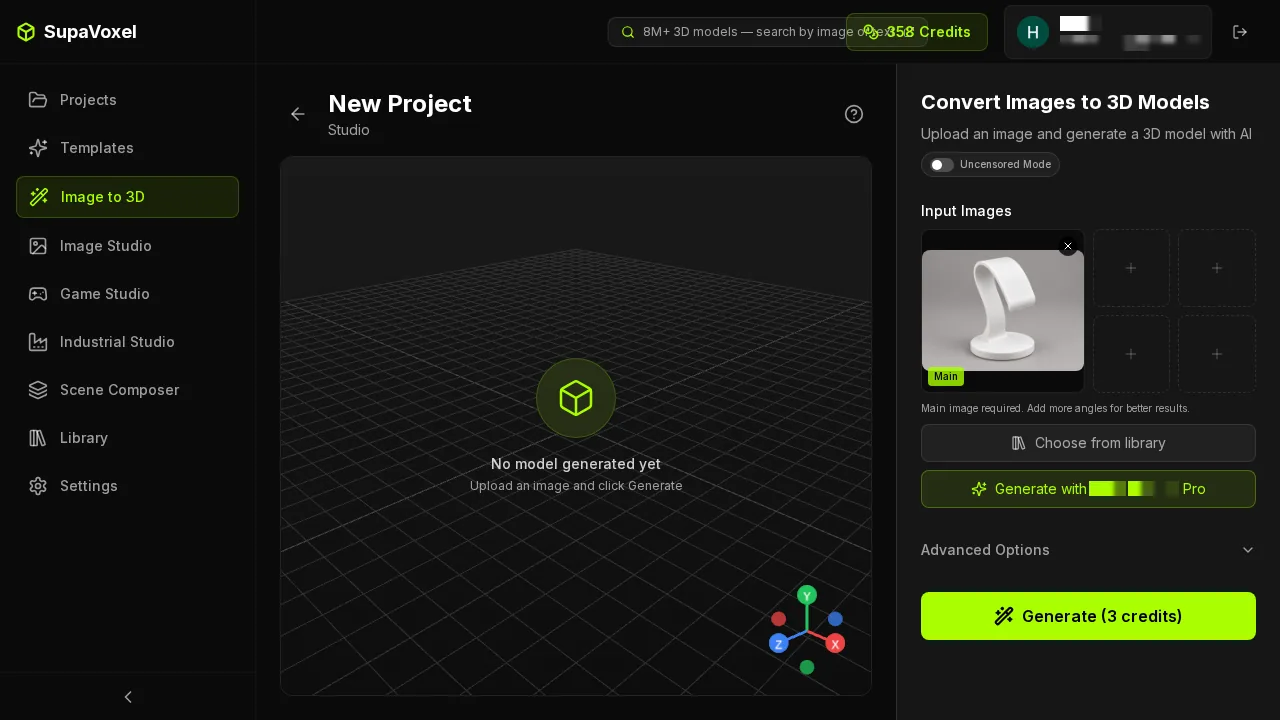
SupaVoxel after upload: still "Generate (3 credits)". The number did not move because it never depended on the image.
Fifty-five credits, revealed at the last step, for one 120 mm watch stand. That is the whole pricing story in two screenshots.
The toggle that decides your topology is a two-use trial
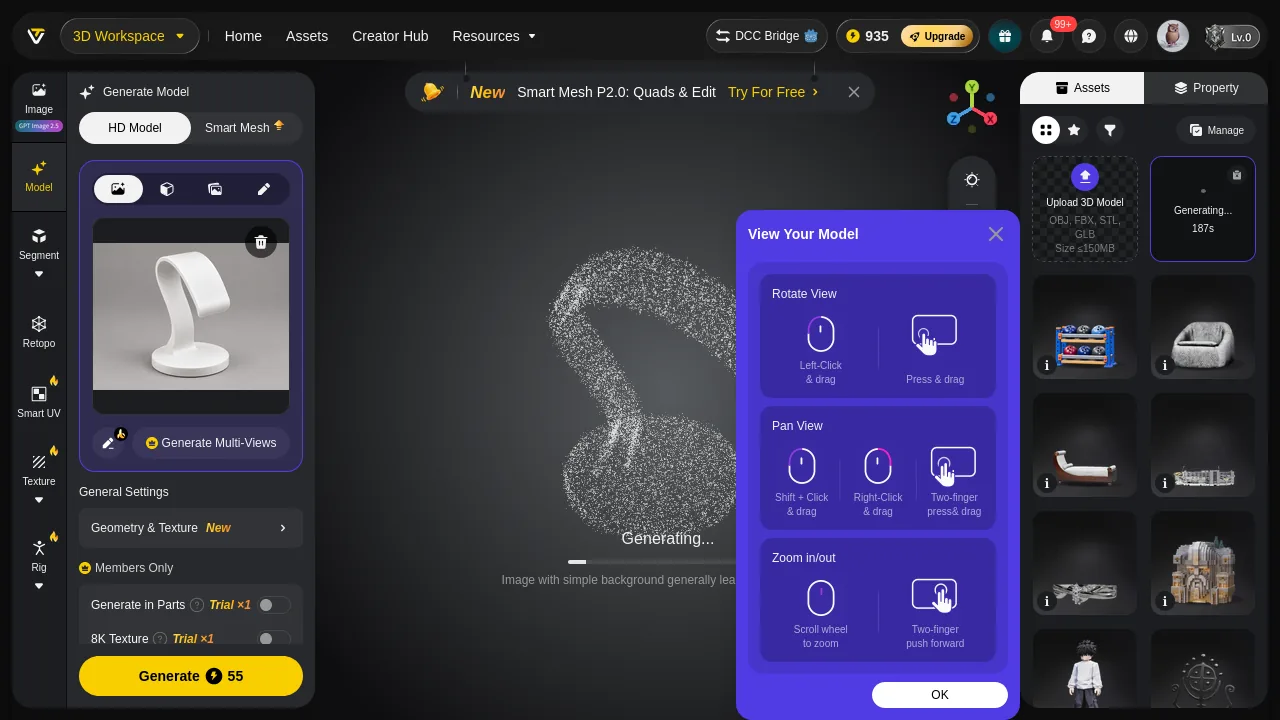
Tripo mid-generation: Generating… 187 s, a Smart Mesh P2.0 — Try For Free banner across the top of the viewport, and in the left rail Generate in Parts (Trial ×1) and 8K Texture (Trial ×1), both Members Only, both off. Balance already 935.
Clean Topology in Tripo is not a setting, it is a sample. Two uses, off by default, and this run used the default like any first-time user would. The result carried 1,995,520 triangles and a winding-inconsistent mesh — the part Clean Topology presumably addresses is the part Tripo rations.
- Usage-limited toggles — Tripo 3 badged Trial ×N · SupaVoxel 0 · nothing in the SupaVoxel panel is rationed
- Members Only gates — Tripo Generate in Parts, 8K Texture · SupaVoxel none on hobbyist
- What 55 credits unlocked — Tripo the default path only · the rest of the panel stays locked
SupaVoxel's advanced panel, for comparison
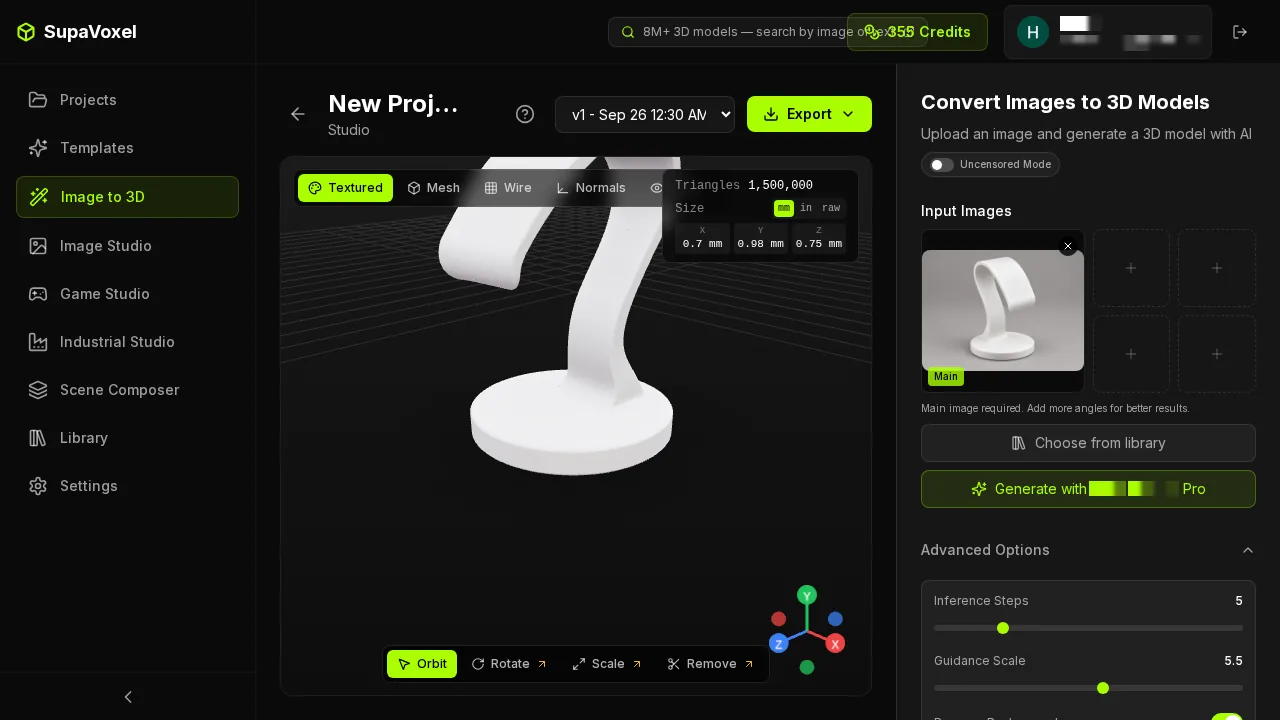
Advanced Options on the SupaVoxel side: Inference Steps 5, Guidance Scale 5.5 — real numbers, all available on the hobbyist tier, nothing badged Members Only or Trial ×N. I opened it to read the values and moved no slider.
Both runs were pure defaults. The difference is that on the SupaVoxel side the defaults are the whole product, and on Tripo's side the defaults are the part you are allowed to keep using.
The balance ledger, both sides
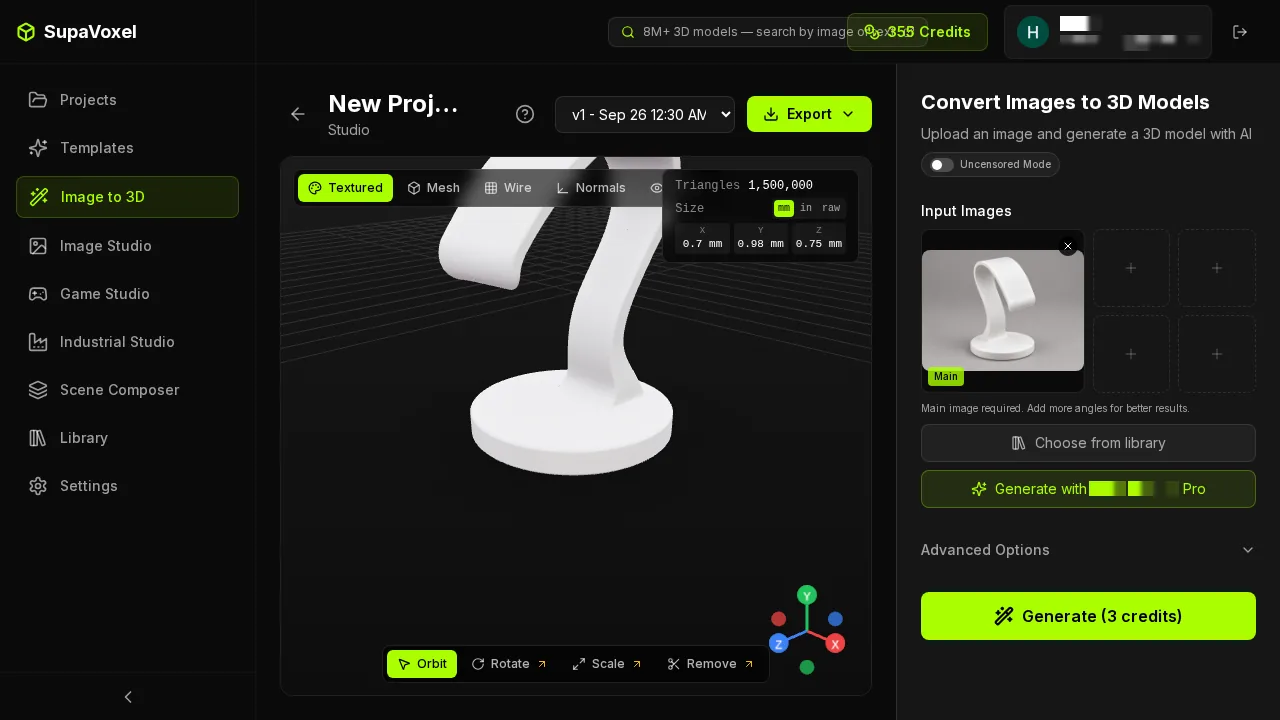
SupaVoxel's result page: Triangles 1,500,000, millimetre dimensions, four inspection modes, a timestamped version (v1 – Sep 26 12:30 AM) and a permanent Export dropdown.
- Tripo balance — 990 before · 935 during generation · 55 charged on submit
- SupaVoxel balance — 358 before · 355 after · 3 charged, reconcilable to the digit
- Retries offered — Tripo Free Retry (×3) on the result card · SupaVoxel re-runs cost credits, versions are kept
Tripo charges at submission, which means a result you do not like has already cost you 55 credits, and the three free retries are the product's own admission that this happens.
Time: Tripo won this subject, SupaVoxel usually wins, Tripo never surprises
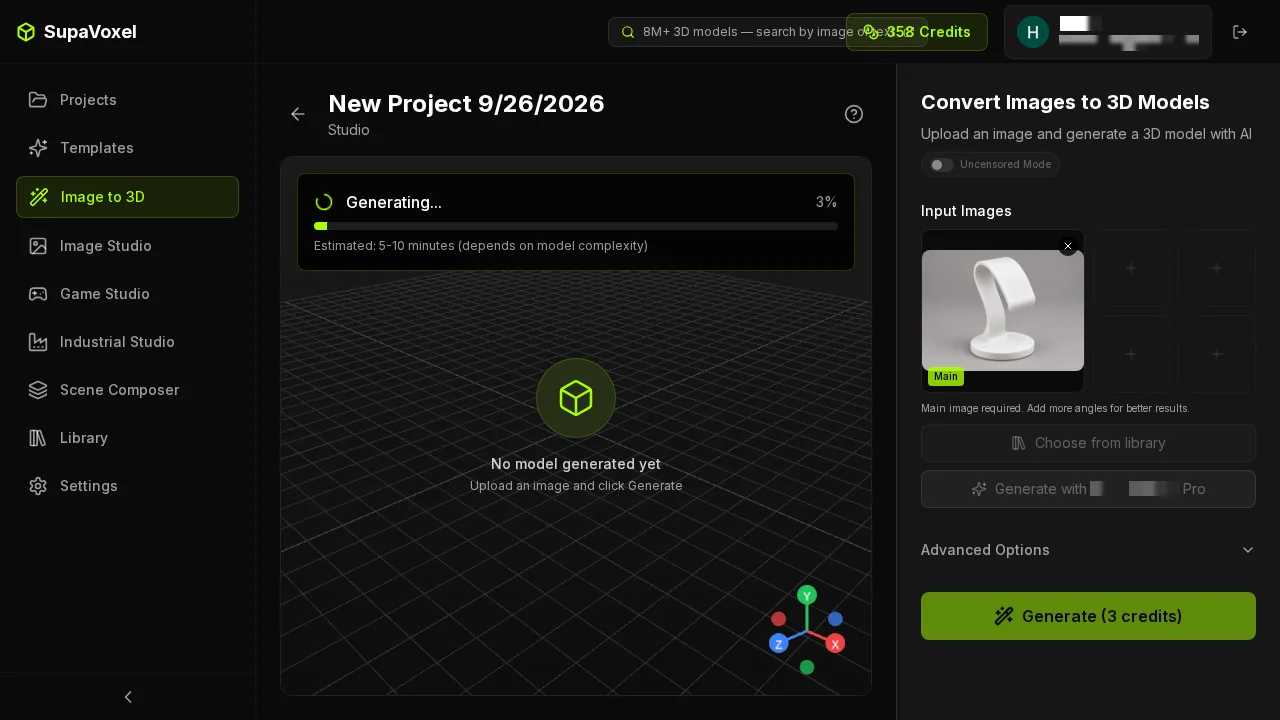
The SupaVoxel generation in progress: a numeric progress bar at 3% and an estimate of 5–10 minutes. No banner, no modal.
Straight facts, stopwatch only. On this watch stand Tripo finished in 160.0 seconds and SupaVoxel in 250.2 seconds. Tripo won this subject by 90 seconds and I am not going to shade that.
But one subject is not the story, and this is where I have to give you two sentences instead of one, because either alone would mislead you.
First: SupaVoxel is usually the faster tool. Across the ten subjects I ran through both, SupaVoxel finished first on seven of ten, with a median of 133.6 s against Tripo's 163.5 s. This watch stand is one of the three where Tripo won. If I had tested only this object I would have told you Tripo is faster, and I would have been wrong about the other seven.
Second: Tripo is far more predictable. Every one of Tripo's ten runs landed between 135 s and 189 s — a 54-second band. SupaVoxel's ten ran 100.2 s to 867.4 s — a 767-second spread. So SupaVoxel is usually quicker and occasionally fourteen minutes. Tripo is usually slower and never once surprised me. This subject is one of the three that make that second sentence true: SupaVoxel's 250.2 s here is nearly double its own median.
- This subject — Tripo 160.0 s · SupaVoxel 250.2 s · Tripo by 90 s
- Median across ten subjects — Tripo 163.5 s · SupaVoxel 133.6 s · SupaVoxel by 30 s
- Range across ten subjects — Tripo 135–189 s (54 s spread) · SupaVoxel 100.2–867.4 s (767 s spread)
- Won the clock — Tripo 3 of 10 · SupaVoxel 7 of 10
- What that is worth as evidence — one run per tool per subject, ten subjects. A sample, not a statistic.
Which of those two facts you should care about depends entirely on what you are doing. Waiting on one model with something due? Tripo's ceiling is 189 s and you can plan around it; SupaVoxel's tail is where a bad afternoon comes from. Queuing up a batch overnight, where the median is what you pay and one slow item costs nothing? SupaVoxel's 133.6 s wins, and so does its 3 credits.
And the time is not free either way. Tripo's 55 credits against 3, a 60.77 MB download against 7.70 MB, and a mesh whose face winding is inconsistent — so on the run where Tripo saved you 90 seconds, you spend some of them flipping normals before you can slice.
A hundred pieces: 5,500 credits against 300
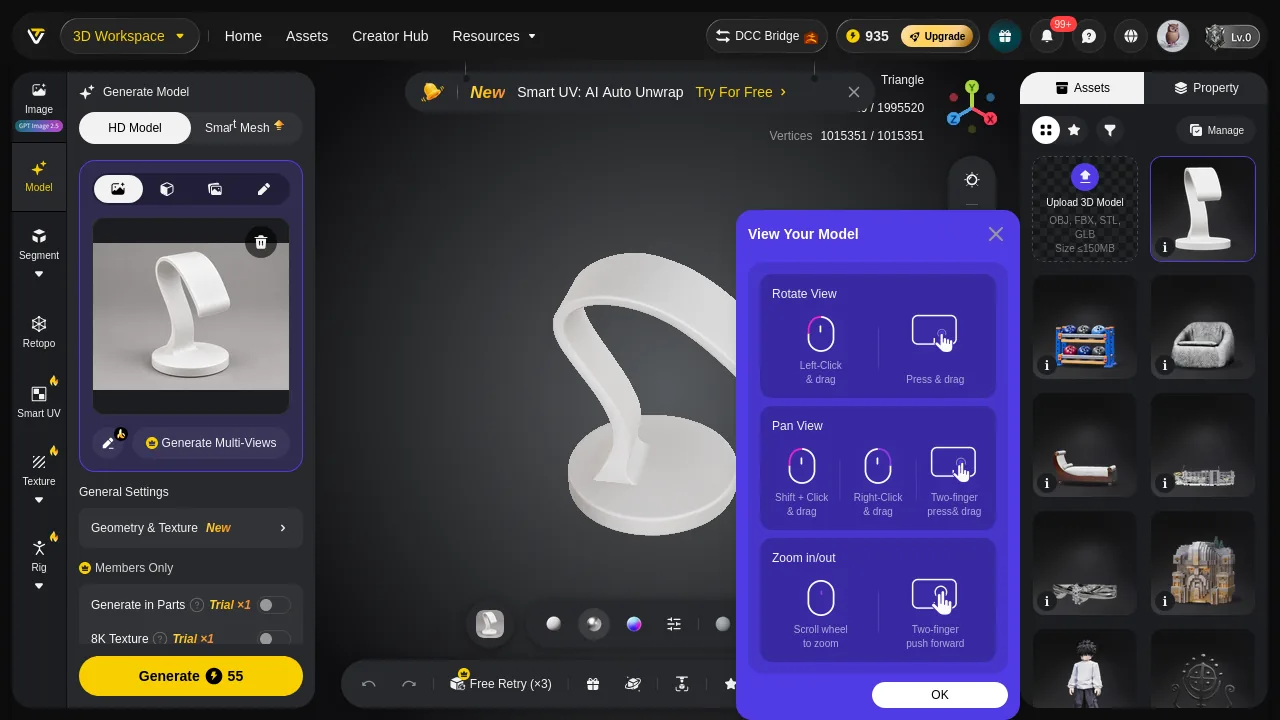
Tripo's finished card, behind a View Your Model dialog you dismiss before you can inspect what 55 credits bought. Free Retry (×3) at the bottom.
- Credits ×100 — Tripo 5,500 · SupaVoxel 300 · 5,200 saved
- Download ×100 — Tripo 6.08 GB · SupaVoxel 0.77 GB · 5.3 GB saved
- Serial hours ×100 — Tripo 3.8–5.2 h · SupaVoxel 2.8–24.1 h · nobody wins this row
- Normals repairs ×100 — Tripo 100 · SupaVoxel 0
The wall-clock row at volume is the one I have to refuse to call. Scaling my ten subjects up, a hundred pieces run one after another lands Tripo somewhere in 3.8–5.2 hours and SupaVoxel somewhere in 2.8–24.1 hours. Those overlap, so any "finishes X hours sooner" claim in either direction is made up — it depends entirely on which hundred objects you feed it. What does not depend on the subjects: 5,500 credits against 300, and a hundred meshes that each need a winding fix against none.
Resin, the one running cost where Tripo is cheaper
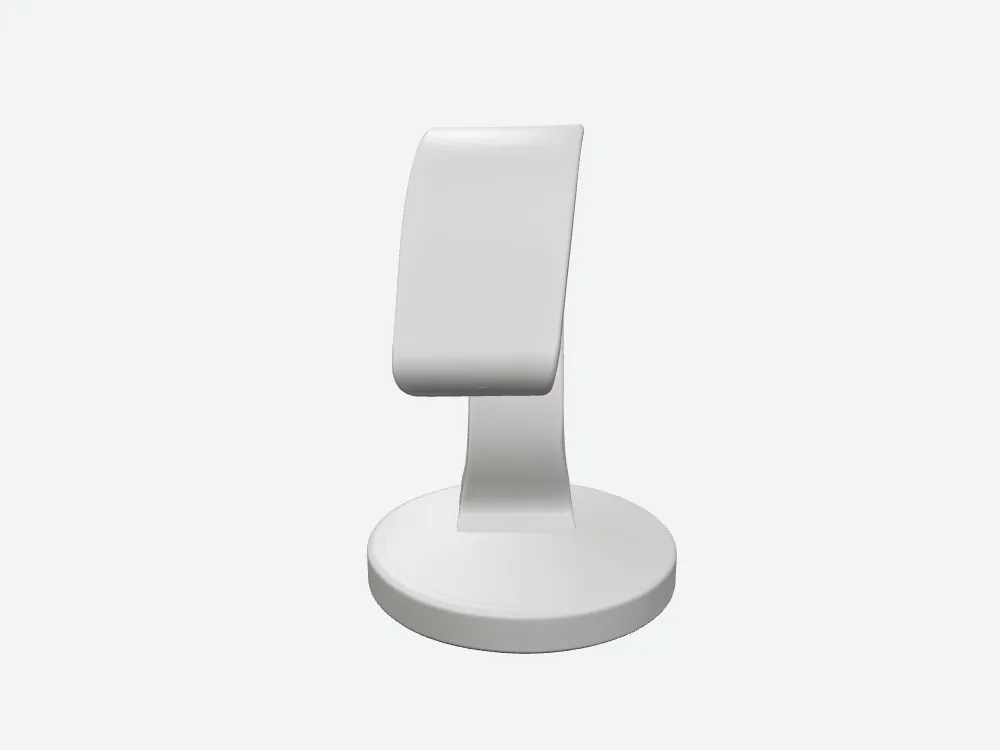
Tripo's model: narrower arch, straighter column, 102.43 cm³ at 120 mm tall.
- Resin per print at $35/L — Tripo $3.59 · SupaVoxel $3.95 · Tripo $0.36 cheaper
- Across 100 pieces — Tripo $359 · SupaVoxel $395 · $36 of difference
Thirty-six dollars per hundred pieces, against 5,200 credits per hundred pieces. That is the entire economic argument in one comparison.
Worth saying plainly: the resin gap is real and it belongs to SupaVoxel. Its model is 112.75 cm³ at 120 mm against 102.43 cm³, about nine percent more material in every piece, and no amount of cheaper generation makes that number go away. It is simply the smallest recurring cost on the sheet, and the only one where the comparison runs the other way.
The bill that keeps arriving: CDN
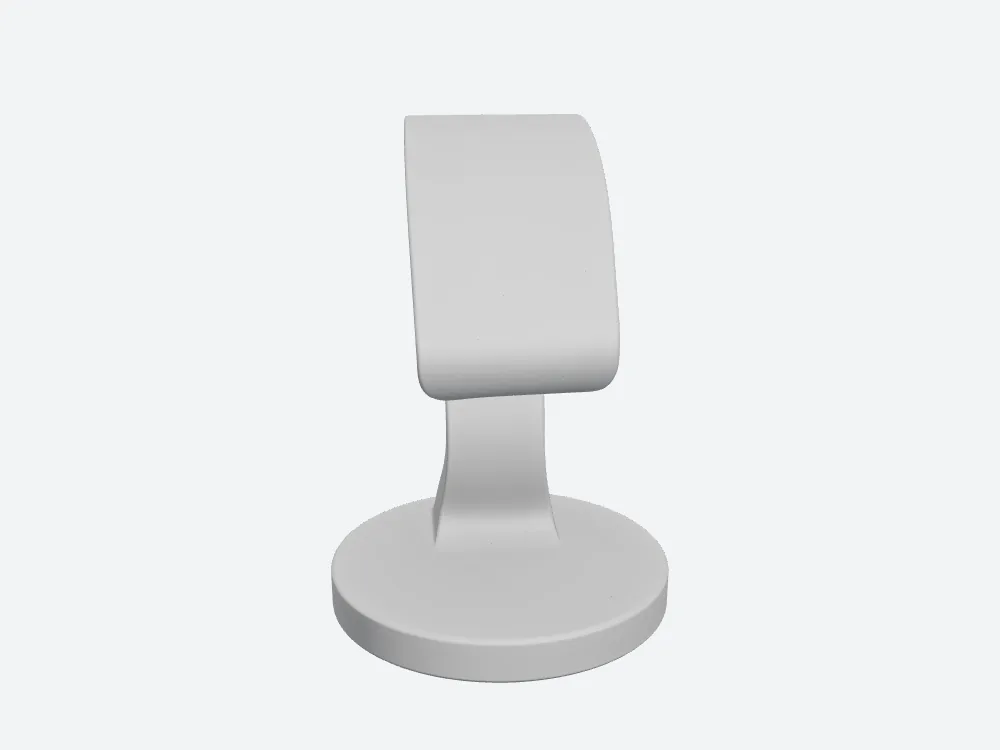
The SupaVoxel model, 7.70 MB on the wire against Tripo's 60.77 MB.
- CDN at 10k loads/month ($0.085/GB) — Tripo $51.65 · SupaVoxel $6.55 · 7.9×
- Same traffic for a year — Tripo $619.80 · SupaVoxel $78.60 · $541.20
- 4G download, one file at 12 Mbps — Tripo 40.5 s · SupaVoxel 5.1 s
If a Tripo model ends up on a product page, the 55 credits were the deposit. Ten thousand views a month adds $45.10 every month, forever, and the visitor waits 40.5 seconds on a phone.
Free retries, versions and what you keep
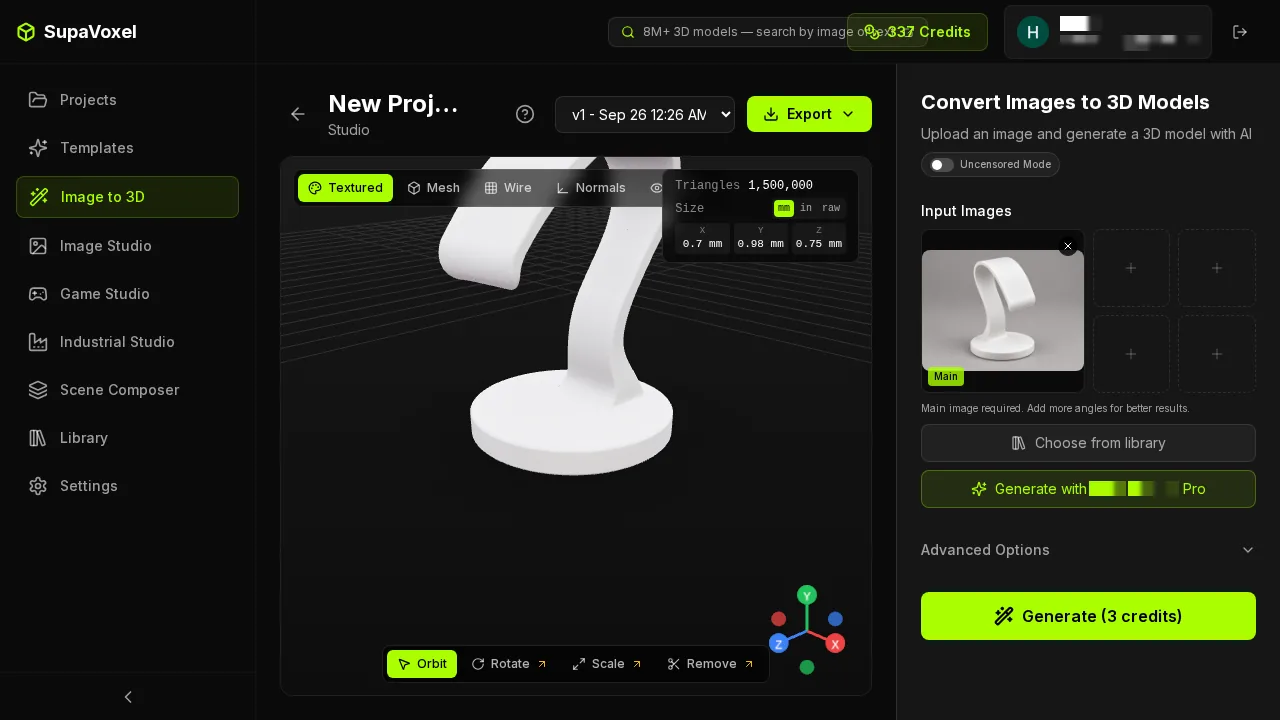
Reopening the SupaVoxel result from Projects: the version record (v1 – Sep 26 12:26 AM) survives, so re-running with new parameters does not overwrite what you already paid for.
Tripo's answer to a bad 55-credit result is three free retries. SupaVoxel's is that each run is a kept version, at 3 credits a run — you can afford to iterate rather than ration retries.
What I could not price
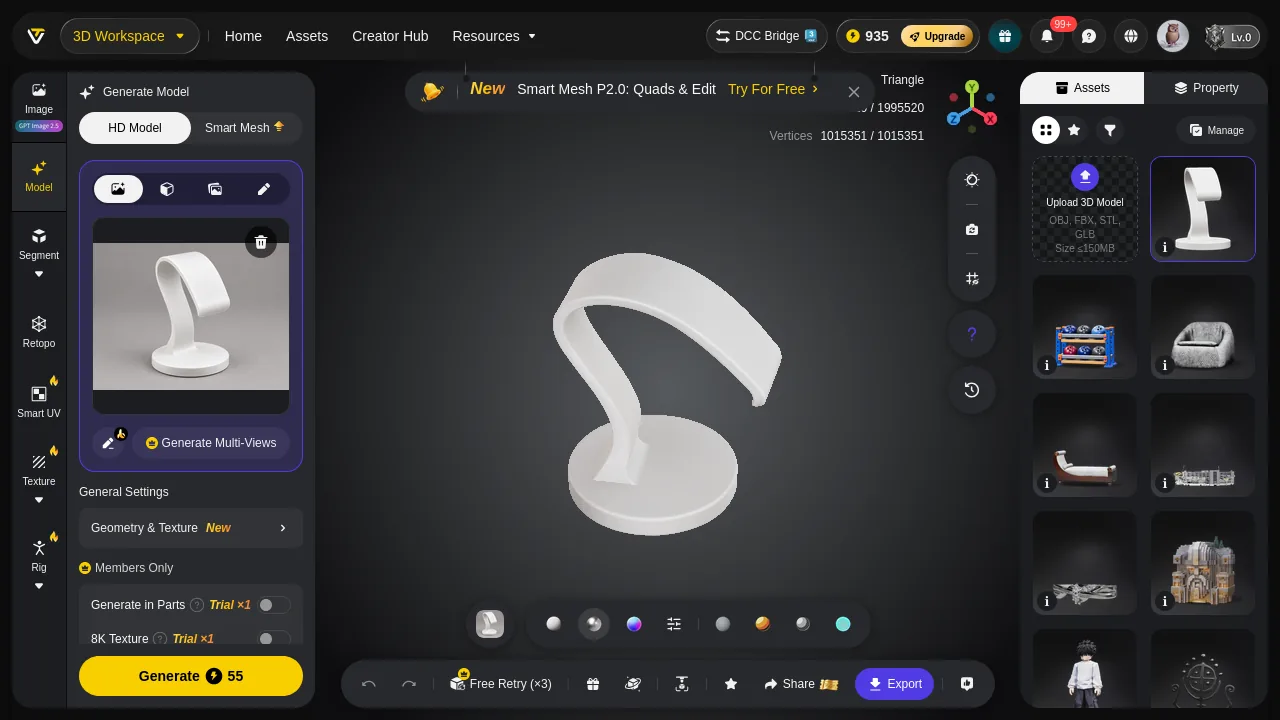
Tripo's viewer after the dialog is dismissed: material spheres and an Export button, plus another Try For Free banner.
- Charge timing on the SupaVoxel side (submit or completion) — not captured this run
- Export formats offered by either product — not captured; I exported GLB on both sides
- Commercial licence terms or subscription tiers — outside this test; every number here is credits, bytes and seconds from runs I paid for myself
Final verdict: Tripo scores 60/100
Tripo beat SupaVoxel to this particular model by 90 seconds, it is the more predictable of the two on time — 135–189 s across all ten subjects — and it is cheaper in resin. It also hides its price until you have uploaded, rations the topology toggle at two uses, charges on submit, and leaves you with a 60.77 MB file that bills you $45.10 a month more at ten thousand loads. And on seven of the ten subjects it was the slower tool, with a median 30 seconds behind. Fifty-five credits against three is 18.3× for that. I would pay the 3.
One run per tool per subject, product defaults, ten subjects — a sample, not a statistic. On timing I am giving you my whole spread rather than the one object that flattered a conclusion.
Which one I would use for this job
For anything you will do more than twice, SupaVoxel is the cheaper meter: 3 credits printed on the button before you upload, no Trial ×N badges, every advanced parameter available on the hobbyist tier, and a 7.70 MB file that does not keep billing you after delivery — supavoxel.com. Take Tripo if you need one model by a deadline and 52 extra credits buys you a predictable clock — it never ran past 189 seconds on me, which is the one thing SupaVoxel could not promise, and I will not pretend otherwise.
Originally published on Medium: Tripo AI Credits Review 2026: 55 Credits for One Watch Stand.