For readers searching hyper3d, this independent Tripo AI review provides a practical comparison with SupaVoxel, covering credit charges, defaults, generation time, and the physical value of the resulting mesh.
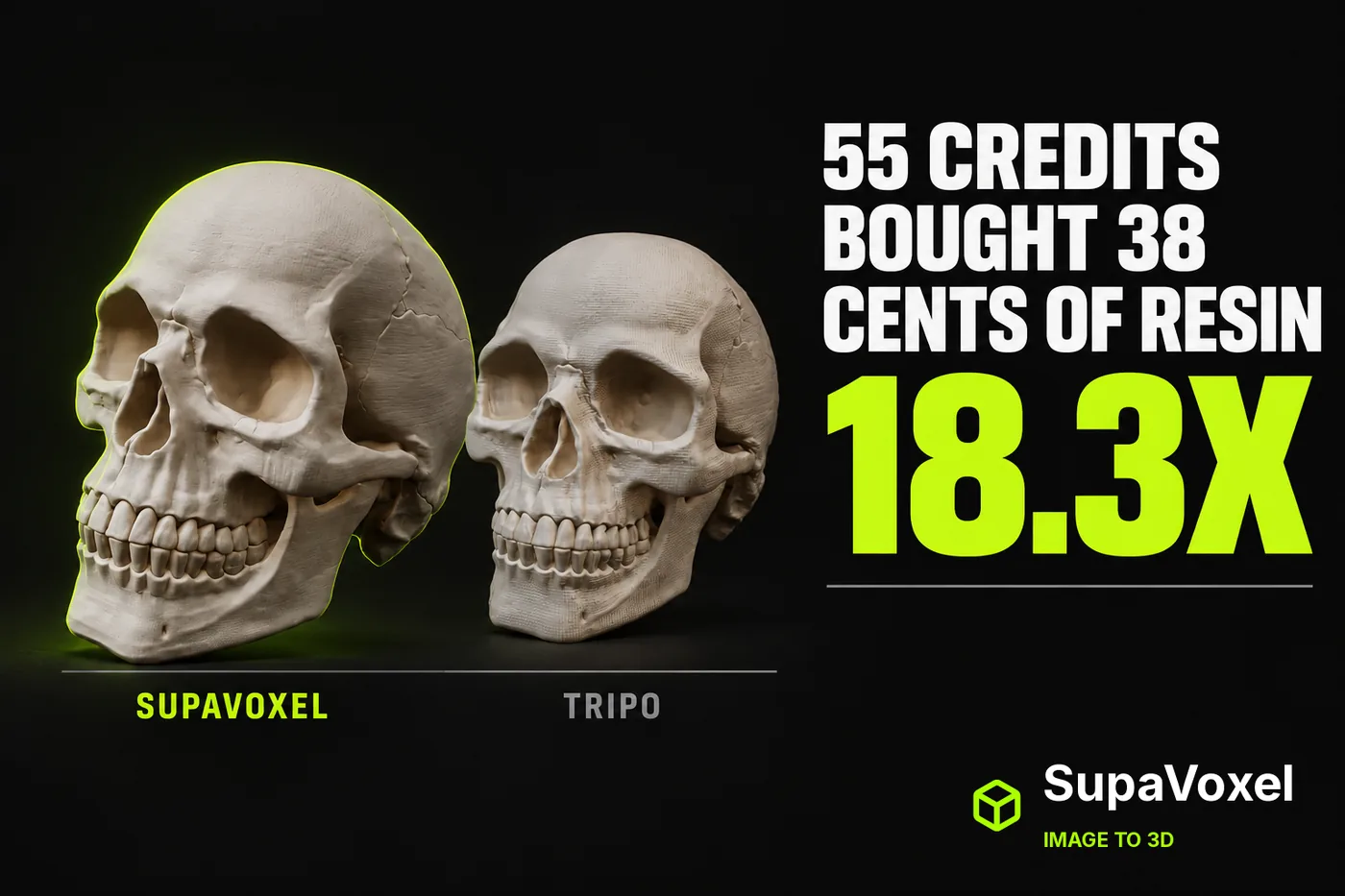
This is an independent test. Nothing here came from vendor access: both tools were used on my own free and paid accounts.
My verdict in 60 seconds — Tripo 58/100, SupaVoxel 91/100
One photograph of an anatomical skull ornament. One generation on Tripo, one on SupaVoxel, both at product defaults. Tripo took 55 credits. SupaVoxel took 3. Then I scaled both results to 120 mm and priced the resin: $16.93 against $16.55. The entire 18.3× credit premium resolves, on the finished object, to thirty-eight cents.
- Credits for one skull — Tripo 55 · SupaVoxel 3 · 18.3×
- Price shown before you commit — Tripo no, the button is blank until upload · SupaVoxel yes, "3 credits" on an empty studio
- When you are charged — Tripo on submit (balance fell 660 → 605 while the card still read "Generating… 111s") · SupaVoxel per request, printed on the project card
- Trial-limited switches — Tripo 3, all off by default · SupaVoxel 0
- Reference images per run — Tripo 1 slot · SupaVoxel 1 main + 4 angle slots
- Time to a model, this case — SupaVoxel 141.2 s · Tripo 189.0 s · and across ten subjects SupaVoxel was quicker on 7 of 10, while Tripo held a 54 s spread against SupaVoxel's 767 s
- A batch of 100 — Tripo 5,500 credits / 6.27 GB · SupaVoxel 300 credits / 0.54 GB
- What the premium buys physically — $0.38 of resin and a mesh 1.37× finer than a 0.4 mm nozzle can print
Four things worth knowing before you top up. Tripo's Generate button carries no number until your image is uploaded, so nothing can estimate the charge before commit. Tripo debits on submission, not on delivery. Tripo's three most interesting switches — Clean Topology, Generate in Parts, 8K Texture — are all off by default and all trial-limited, so a default-settings comparison is a comparison of Tripo's default tier. And on the clock there are two true statements, not one: SupaVoxel is usually quicker — this skull by 48 s, and 7 of 10 subjects overall — while Tripo is far more predictable, a 54-second spread across ten runs against SupaVoxel's 767.
For anything where the credit line matters — a batch, a store, a shop that prints on demand — SupaVoxel is the one I'd use. Tripo costs 18.3× the credits, 11.67× the bytes, and a normals flip before the file slices.
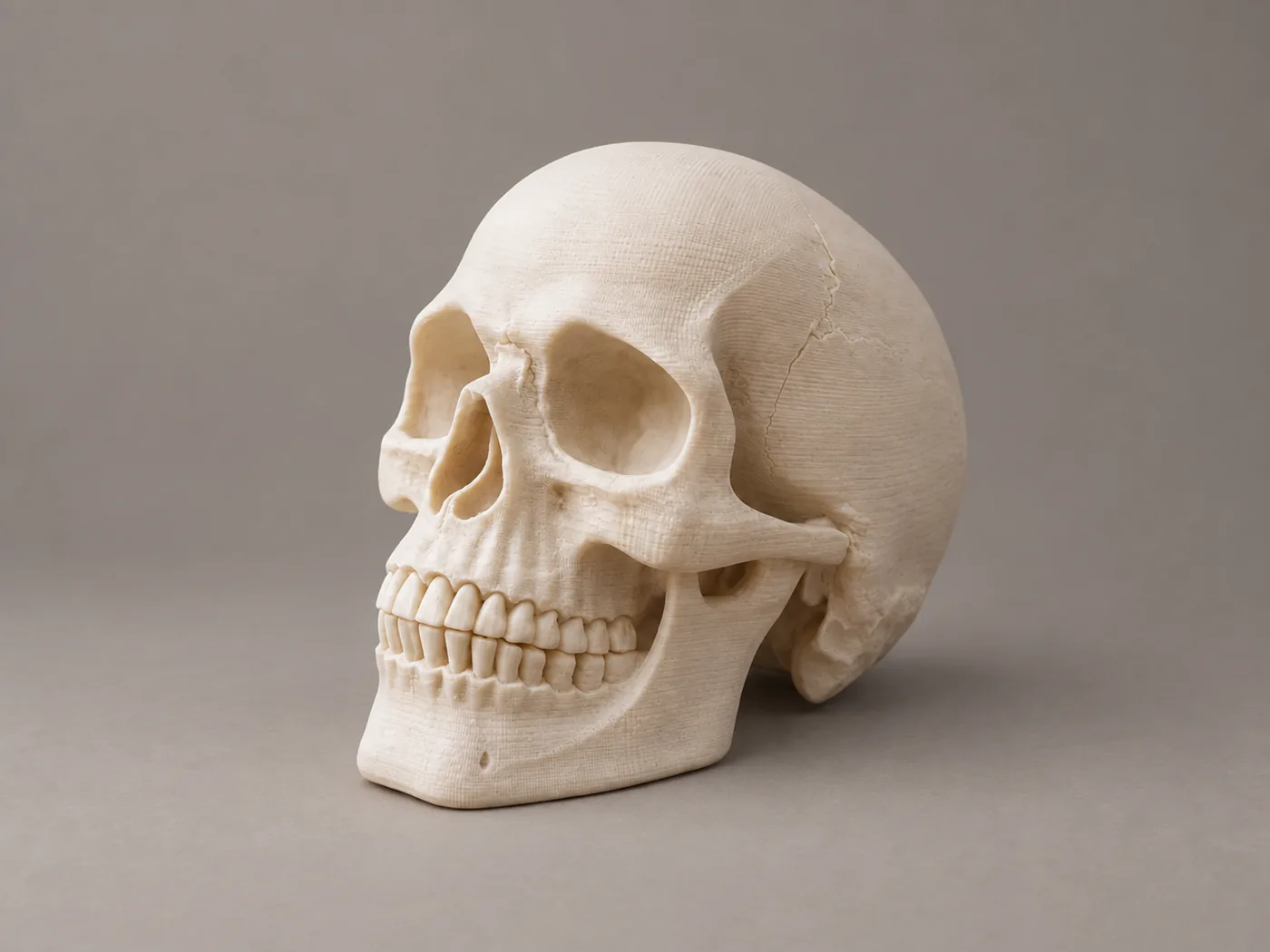 The one input, 1,680,710 bytes, identical sha256 on both sides. A three-quarter view with full occlusion, a free-standing zygomatic arch, a parietal crack and a layer of horizontal wood grain.
Tripo's price does not exist until you upload
Open Tripo's studio and the Generate button carries no number at all. Upload the skull photo and the same button becomes Generate 55. That ordering is the whole finding: there is no point in the flow, before you have committed an image, where a script or a person can read the cost of the job it is about to run.
On the SupaVoxel side the button says 3 credits on an empty studio, before any file exists, and it still says 3 credits after the upload. Uploading does not move SupaVoxel's price.
- Price on an empty studio — Tripo none · SupaVoxel 3 credits
- Price after upload — Tripo 55 · SupaVoxel 3 · unchanged
 Tripo's studio before upload. A bare Generate button — no price. Three things are selling at once on this screen: Upgrade beside the balance, a promo bubble sliding in top-right, and a WEEKLY CHALLENGE card below.
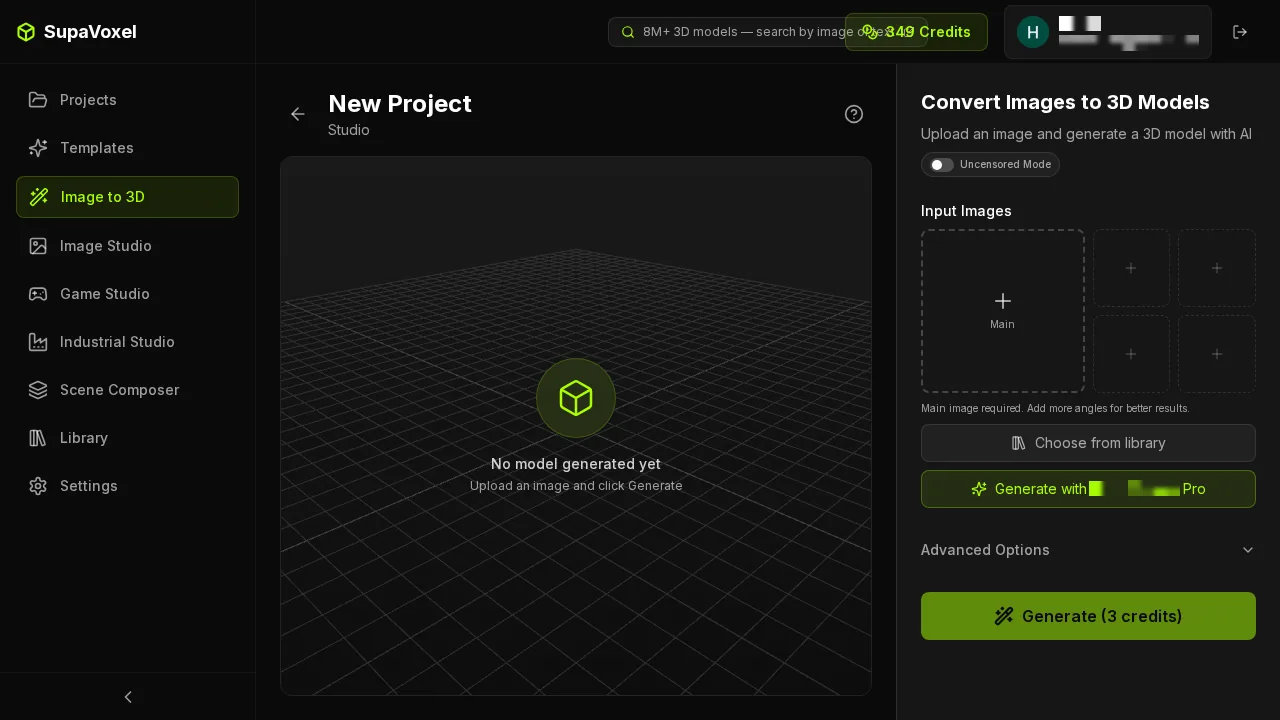 SupaVoxel's studio before upload. Five reference slots on the right and "3 credits" already printed on the Generate button.
Tripo charges on submit, not on delivery
Mid-generation, Tripo's balance had already gone from 660 to 605 while the job card still read "Generating… 111s". Fifty-five credits, debited before there was a mesh to look at. If the result is not what you wanted, the credits are already gone and the remedy is the Free Retry (×3) that appears on the bottom bar after completion.
Second-order number: at 55 credits per submission, a shop that discards one result in four is paying 73 credits per usable skull on Tripo, against 4 on SupaVoxel.
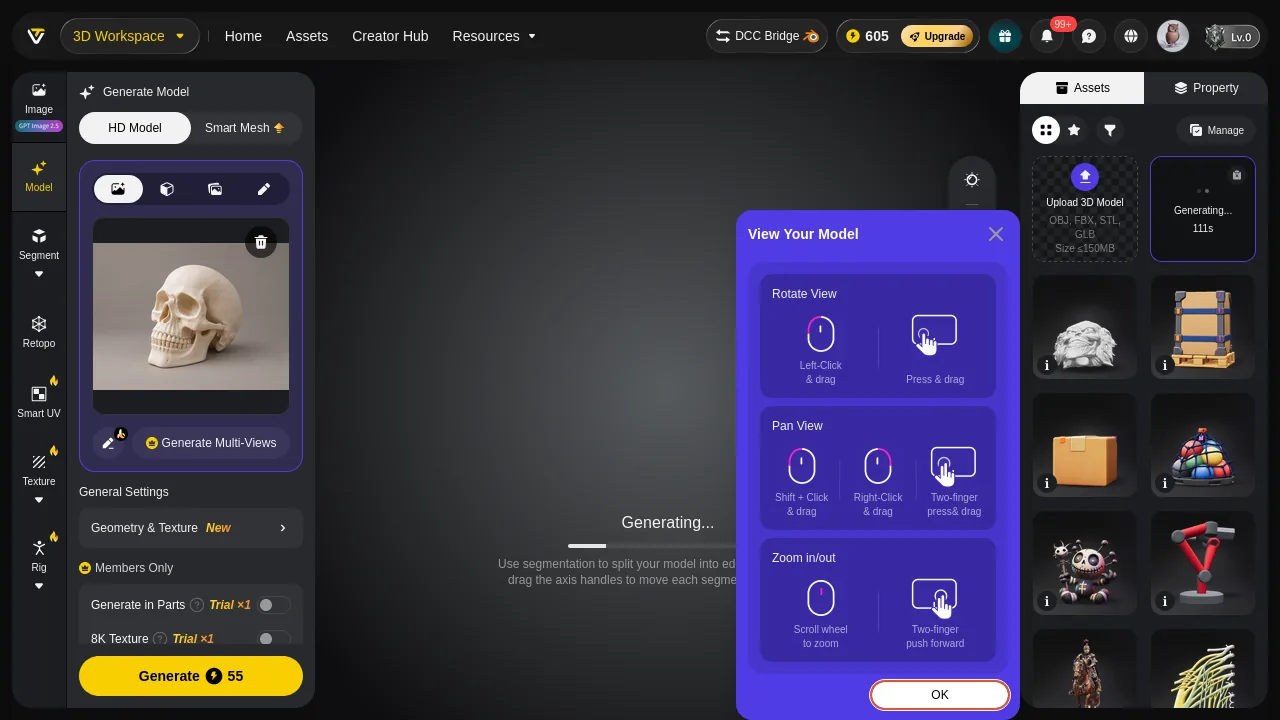 Tripo generating. Balance already 605. In the left rail, Generate in Parts (Trial ×1) and 8K Texture (Trial ×1) sit under Members Only, both off. A "View Your Model" tutorial modal covers the viewport.
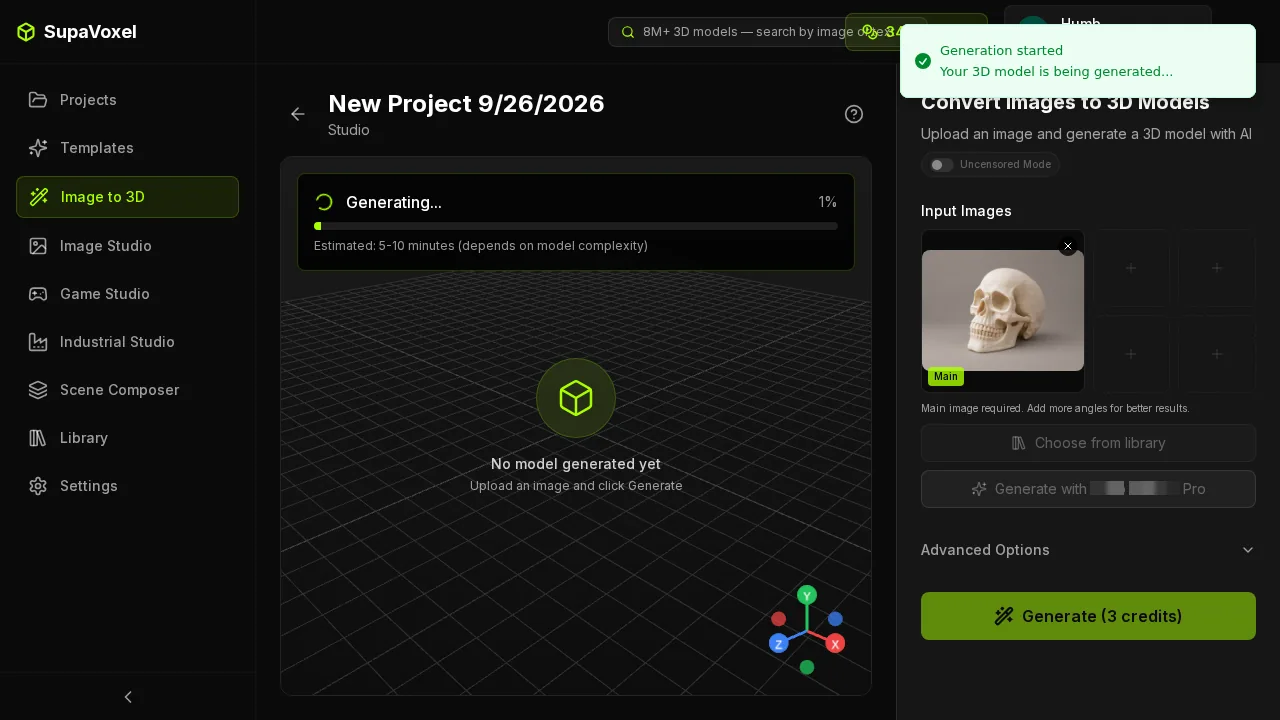 SupaVoxel generating: 1% with an honest "Estimated: 5–10 minutes (depends on model complexity)" range and no modal over the viewport.
Three trial-limited switches, all off
Tripo ships three switches that plausibly change the answer, and all three are off by default with a finite trial counter attached: Clean Topology (Trial ×2), Generate in Parts (Trial ×1) and 8K Texture (Trial ×1), the last two filed under Members Only. To test Tripo's best tier you have to spend one of a countable number of attempts.
That has a consequence for every default-settings review of Tripo, including this one: what got measured is Tripo's default tier, because that is the tier that is actually repeatable. SupaVoxel has zero trial-limited switches — every option on its panel can be run as often as your credits allow.
- Trial-limited switches — Tripo 3 (×2, ×1, ×1) · SupaVoxel 0
- Switches behind a membership tier — Tripo 2 · SupaVoxel 0
 After upload: Generate 55. Clean Topology is still off with Trial ×2 beside it.
One reference image against five slots
Tripo accepts a single reference image per run. SupaVoxel accepts a main image plus four extra angles, five in total. For this case I deliberately used only one on both sides so the inputs matched.
It matters more than it sounds for a skull photographed from the front-three-quarter. The back of the cranium has no pixels in the input at all, so both products had to invent it — and on Tripo there is no mechanism to constrain the invention, because there is nowhere to put a rear photograph. That limit costs nothing in credits and everything in what you can fix.
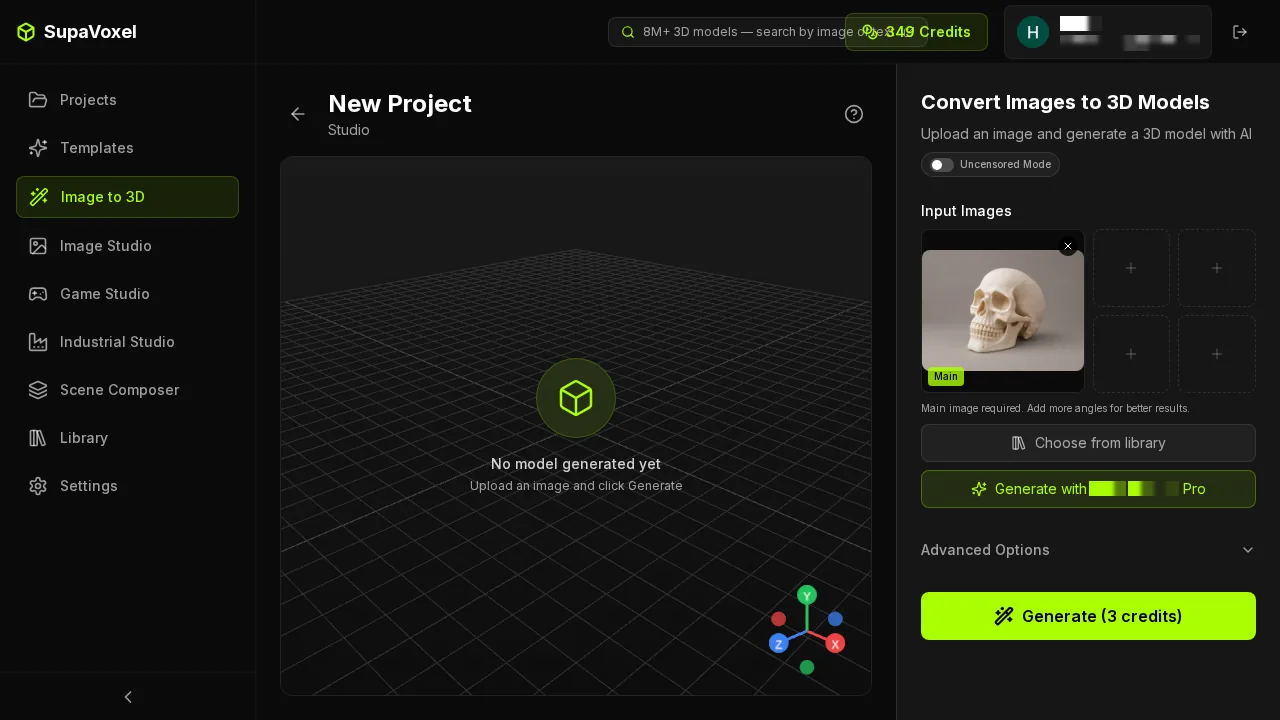 The skull in SupaVoxel's Main slot with the four angle slots deliberately left empty to match Tripo's single-image condition. The button still reads 3 credits.
What the 52 extra credits bought: $0.38
Scale both meshes to 120.0 mm tall and measure the solid. Tripo: 483.80 cm³. SupaVoxel: 472.89 cm³. At $35/L that is $16.93 against $16.55 — 2.3% apart, $0.38 in money.
So the physical object you eventually hold is the same object. The premium did buy things — a mean triangle edge of 0.2635 mm against SupaVoxel's 0.3598 mm, a 4096 baseColor texture against a 2048 one, a thinner zygomatic arch, and anatomically correct broad chisel-shaped incisors where SupaVoxel's taper to points. What it did not buy is size, weight, resin, support area (8,837.9 mm² against 8,544.5 mm², 19.06% against 19.01%) or one single feature on the occiput, which both products invented as a featureless egg.
- Resin at 120 mm — Tripo $16.93 · SupaVoxel $16.55 · $0.38
- Credits for that $0.38 — Tripo 55 · SupaVoxel 3
- Support area — Tripo 8,837.9 mm² · SupaVoxel 8,544.5 mm² · effectively tied
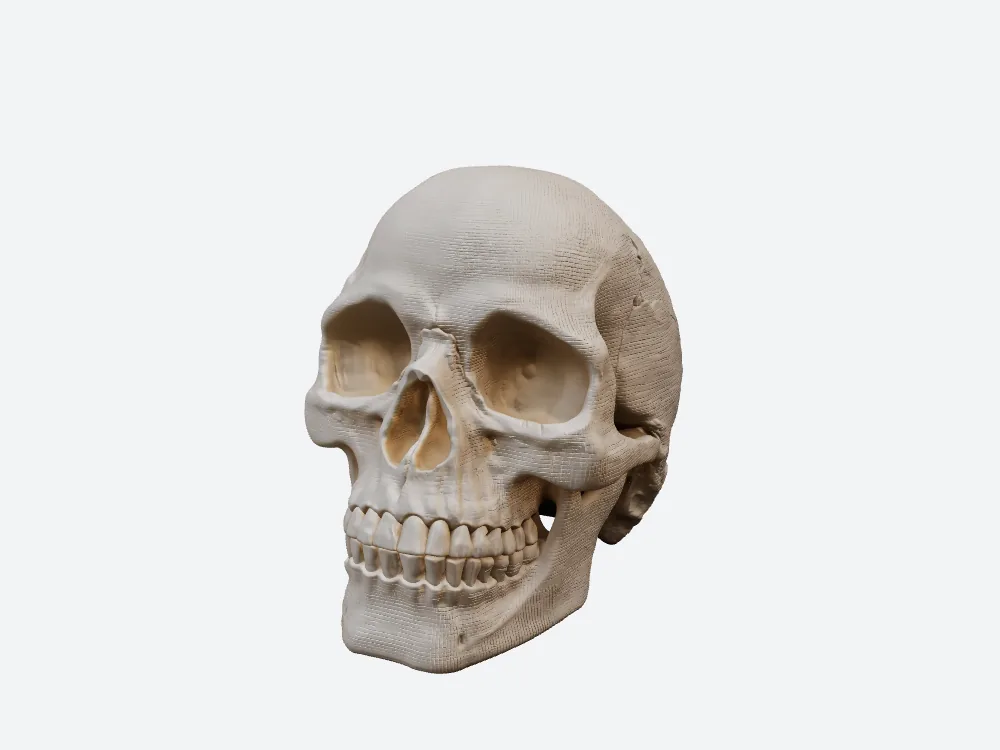 Tripo's 55-credit skull, offline render at 1,952,540 triangles.
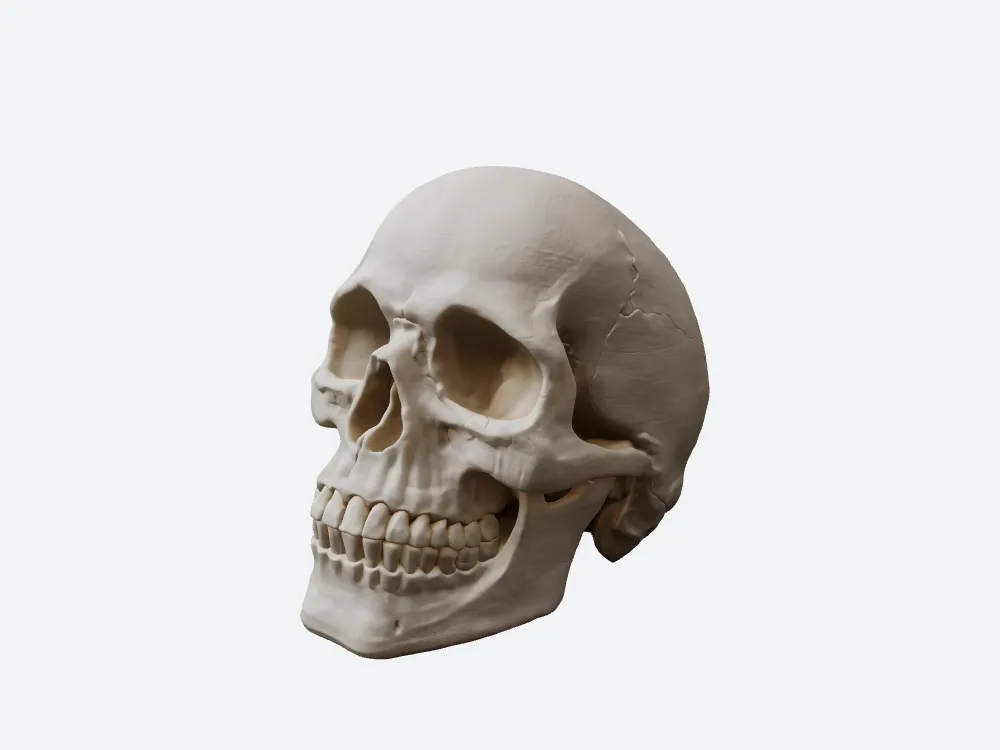 SupaVoxel's 3-credit skull at the same camera, 960,138 triangles. The object you print out of these two files costs $16.93 and $16.55 in resin respectively.
A batch of 100 skulls: 5,500 credits against 300
Small workshop arithmetic, one hundred pieces:
- Credits — Tripo 5,500 · SupaVoxel 300 · 5,200 saved
- Total download — Tripo 6.27 GB · SupaVoxel 0.54 GB · 5.73 GB saved
- Total resin — Tripo $1,693 · SupaVoxel $1,655 · $38 apart
- Repair work — Tripo 100 normals flips · SupaVoxel 100 solidify merges, both scriptable
The credit column and the bandwidth column are the only two that move. The resin column is $38 across an entire production run. Anyone arguing that Tripo's extra credits are buying material quality has to explain a $38 difference across a hundred pieces.
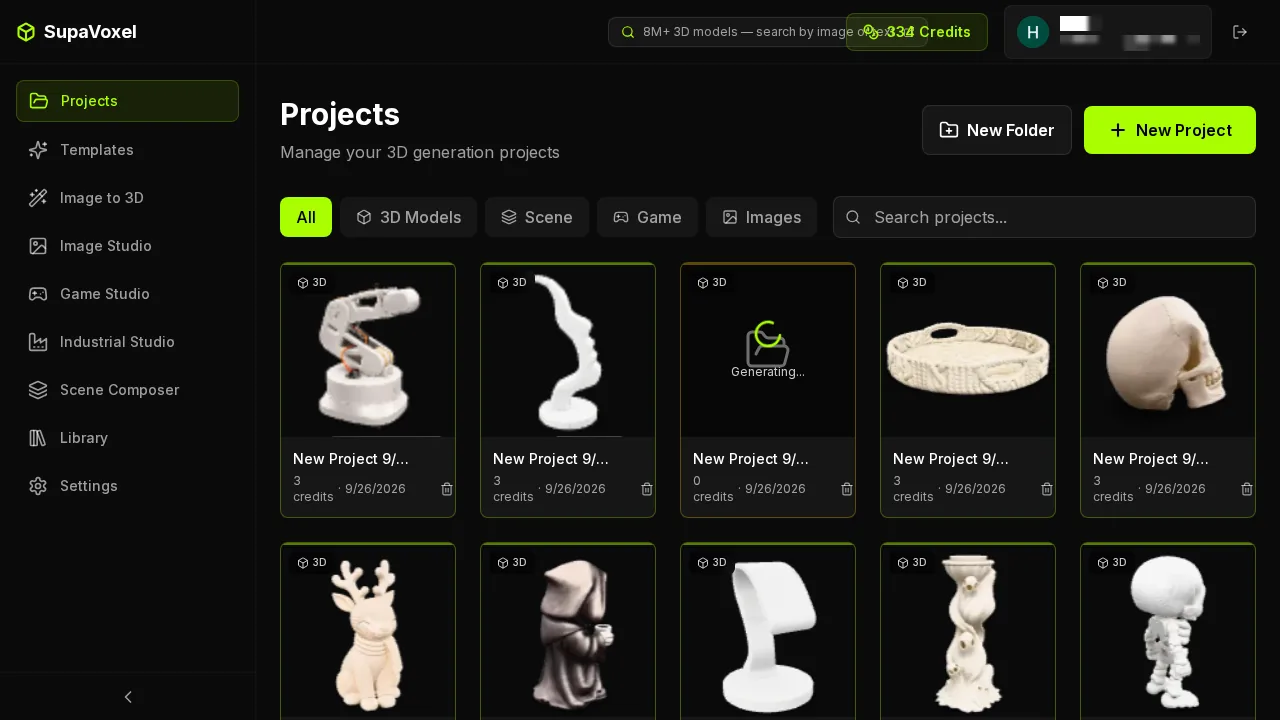 SupaVoxel's Projects grid: every card prints its own credit charge and date, including a running job at 0 credits. You can reconcile spend from the list view.
The clock: SupaVoxel is usually quicker, Tripo is far more predictable
Both halves of this belong in the same paragraph, because either one alone misleads.
On this skull, timed from submit to a downloadable file: SupaVoxel 141.2 s, Tripo 189.0 s. SupaVoxel by 48 seconds. And across the ten subjects I ran through both products, one run per tool per subject, that is the usual direction — SupaVoxel came back first on 7 of 10, median 133.6 s against 163.5 s, about thirty seconds quicker in the middle of the pack.
Now the half that goes the other way, and on a production floor it may matter more. Tripo's ten runs all landed between 135 s and 189 s — a 54-second spread, end to end. SupaVoxel's ran from 100.2 s to 867.4 s, a spread of 767 seconds, with a real tail: 867 s on the tank, 258 s on the reindeer, 250 s on the watch. Tripo is the one you can put a number on before you press the button. SupaVoxel is quicker more often and occasionally takes fourteen minutes.
Worth saying that this case sits at one end of that: 189.0 s is the slowest Tripo run in the whole set, so the 48-second margin here is about as good as this comparison gets for SupaVoxel.
Serial batch of 100 is not a row anyone wins. Tripo lands at 3.8–5.2 h, SupaVoxel at 2.8–24.1 h — the ranges overlap, and which one finishes first depends entirely on what you feed it. Queue width fixes hours anyway; it does not fix credits.
- This case — SupaVoxel 141.2 s · Tripo 189.0 s · SupaVoxel by 48 s
- Across ten subjects, one run each — SupaVoxel first on 7 of 10 · medians 133.6 s vs 163.5 s
- Consistency — Tripo 135–189 s (54 s spread) · SupaVoxel 100.2–867.4 s (767 s spread) · Tripo far more predictable
- Serial 100 — Tripo 3.8–5.2 h · SupaVoxel 2.8–24.1 h · overlapping, no winner
- What is not close on any subject — 18.3× credits, 11.67× bytes
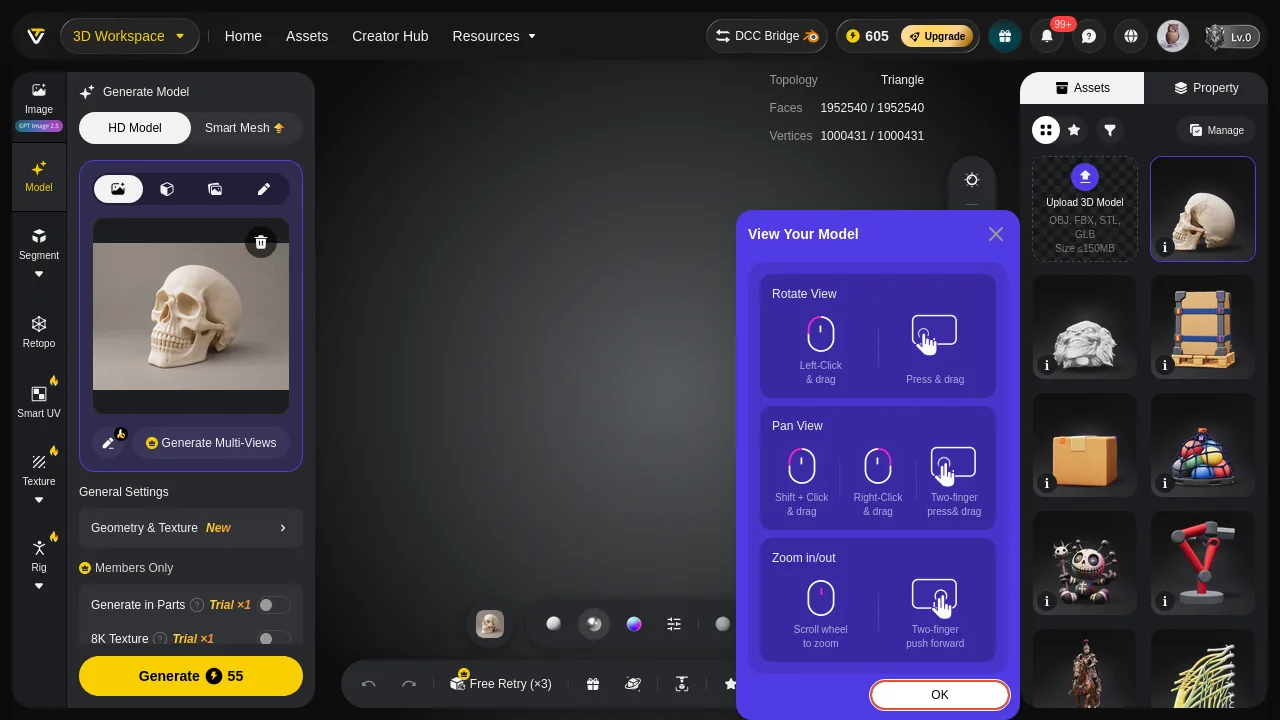 Tripo complete: Faces 1952540 / Vertices 1000431 — matching my offline parse exactly. The tutorial modal is still covering the viewport at this step, so only the top three lines of the readout show.
Bytes are a bill too
The generation charge is not the only line item. Tripo's GLB is 62.70 MB against SupaVoxel's 5.37 MB, 11.67×, and Tripo shipped it with no compression extension at all — 32.11 bytes per triangle against 5.59. On a site serving 10,000 model loads a month at $0.085/GB, that is $53.29 against $4.57 — $48.72 a month, $584.60 a year, for the same skull.
Of Tripo's 7.25 MB of textures, 4.81 MB is metallicRoughness plus normal, which a slicer never opens — including a 3.38 MB uncompressed 4096 PNG normal map. You pay 55 credits to generate it and then you pay CDN rates to serve it.
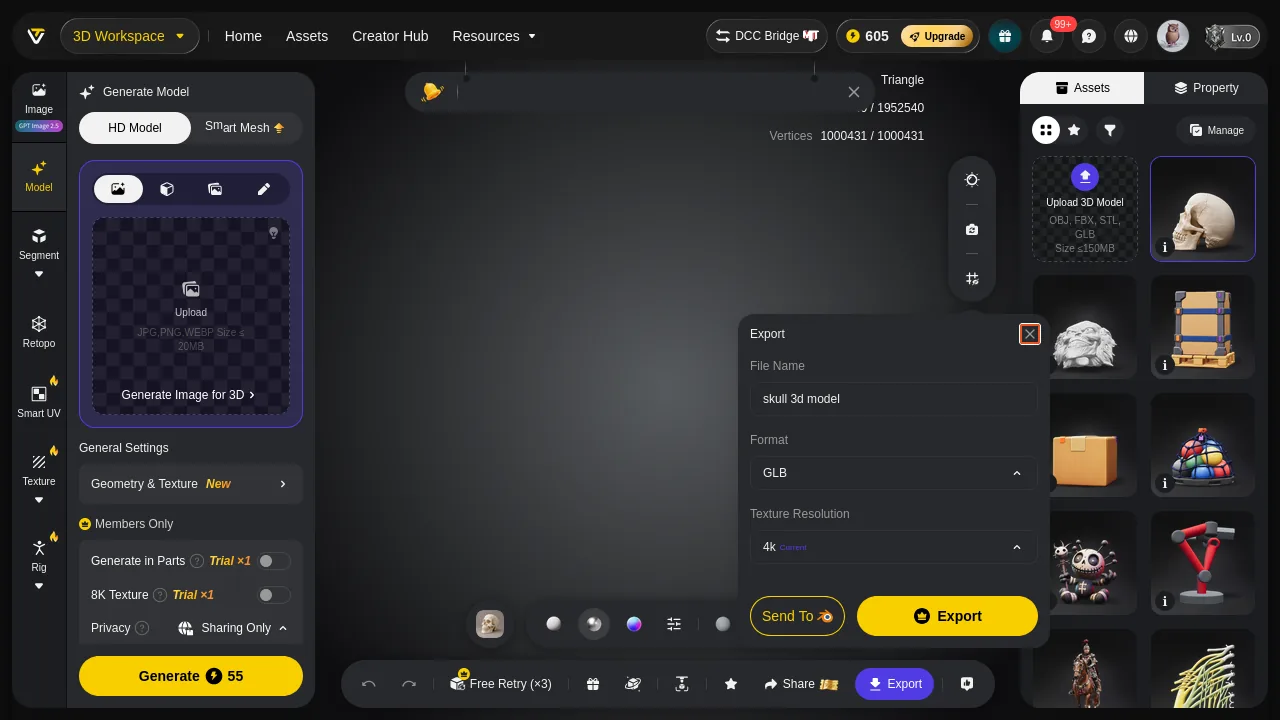 Tripo's export dialog. Texture Resolution defaults to 4k (Current), so a print-only user takes the full set home by default.
The per-project ledger, and Tripo's privacy default
SupaVoxel's result page carries four inspection modes (Textured / Mesh / Wire / Normals), a triangle count that matched the GLB exactly at 960,138, Size X/Y/Z with a mm / in / raw toggle, and a version dropdown. Tripo's viewer, in this run, rendered an empty canvas in a headless browser while still reporting correct Faces/Vertices — so I treated it as a readout, not as geometry evidence.
One more default worth a line on a commercial job: Tripo's Privacy setting on the viewer reads Sharing Only, not private. That is a thing you change yourself, per project, before you generate a client's part.
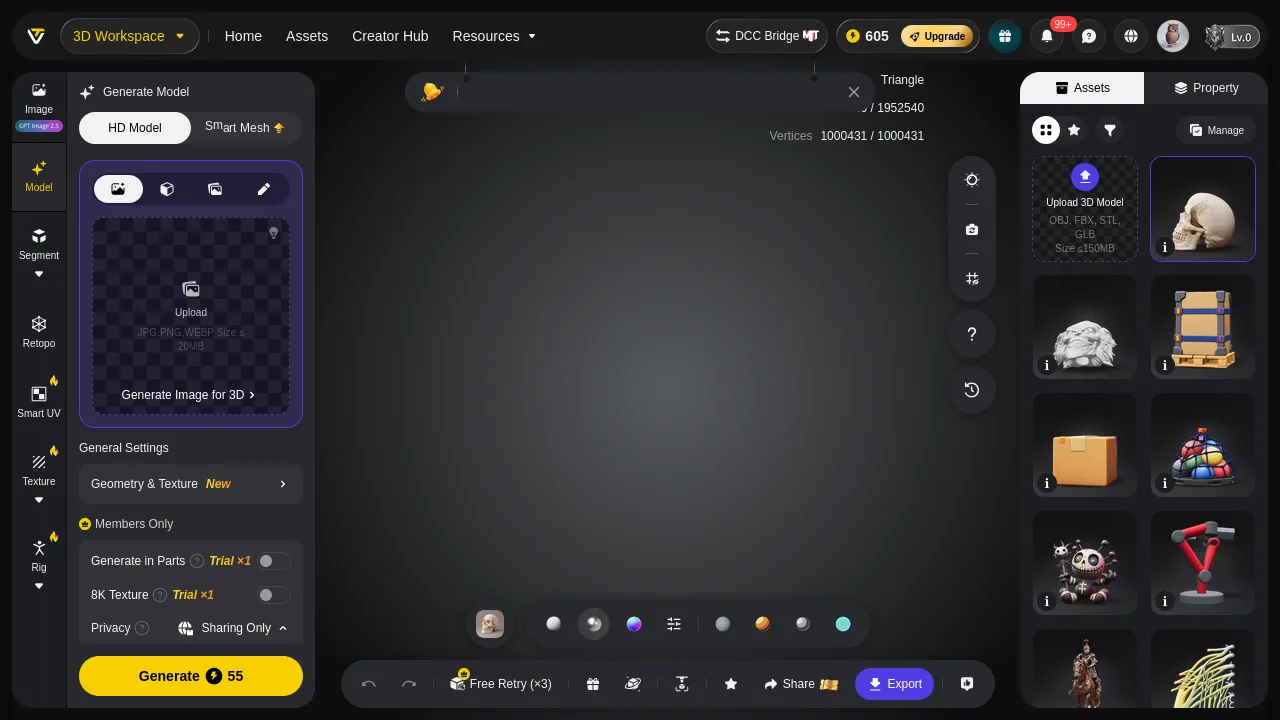 Tripo's viewer. Privacy: Sharing Only. The canvas rendered empty headless, so nothing geometric was read from this screen.
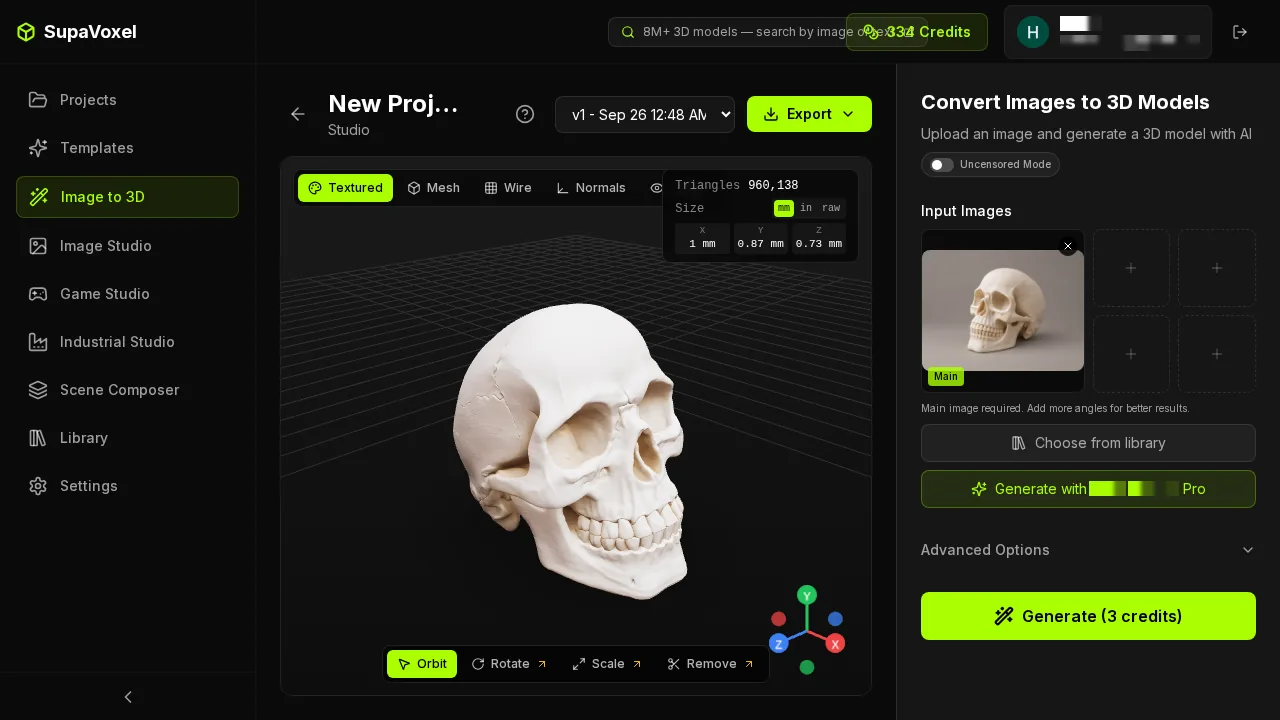 SupaVoxel's result page: four inspection modes, Triangles 960,138, Size X/Y/Z with unit switching, and a version dropdown.
Where Tripo's money is genuinely well spent
Three places, and they are real. Tripo's clock is the one you can schedule against — every run in the set inside a 54-second band, where SupaVoxel's spanned 767 seconds. Tripo's mesh comes back as 3 connected shells with 2 non-manifold edges, where SupaVoxel's is 385 shells and 576 non-manifold edges — Tripo's file is better organised and SupaVoxel's needs a merge. And Tripo's 4096 baseColor at 2.44 MB against 0.28 MB is the better asset if you are rendering rather than printing.
The exchange rate for all three at once: 55 credits against 3, 62.70 MB against 5.37 MB, a normals flip, and a surface with the reference photo's wood grain displaced into the geometry, which is a sanding pass on every printed copy.
Final verdict: Tripo scores 58/100 on cost
Tripo's pricing is 18.3× SupaVoxel's for a result that differs by $0.38 of resin. Tripo hides the number until upload, debits on submit, gates its three best switches behind trial counters, and takes one reference image where SupaVoxel takes five. Tripo earns points back for the tidier shell structure, the better render asset, and a delivery time you can actually plan around. SupaVoxel scores 91/100: 3 credits, priced before you commit, per-card accounting, no trial limits, five input slots, and quicker on 7 of 10 subjects — with two honest debts, a mesh that needs merging and a long tail on the clock that hit 867 s on another subject in this set.
Which one I would use for this job
3 credits a model, the price on the button before you upload, five reference slots, and a 5.37 MB file that does not bill you again every time someone loads it — supavoxel.com.
Originally published on Medium: Tripo AI Review 2026: 55 Credits Bought $0.38 of Extra Resin.