For readers evaluating hyper3d workflows, this review examines Tripo AI’s reconstruction of a photographed robotic arm and compares its geometry, printability, and cost with SupaVoxel.
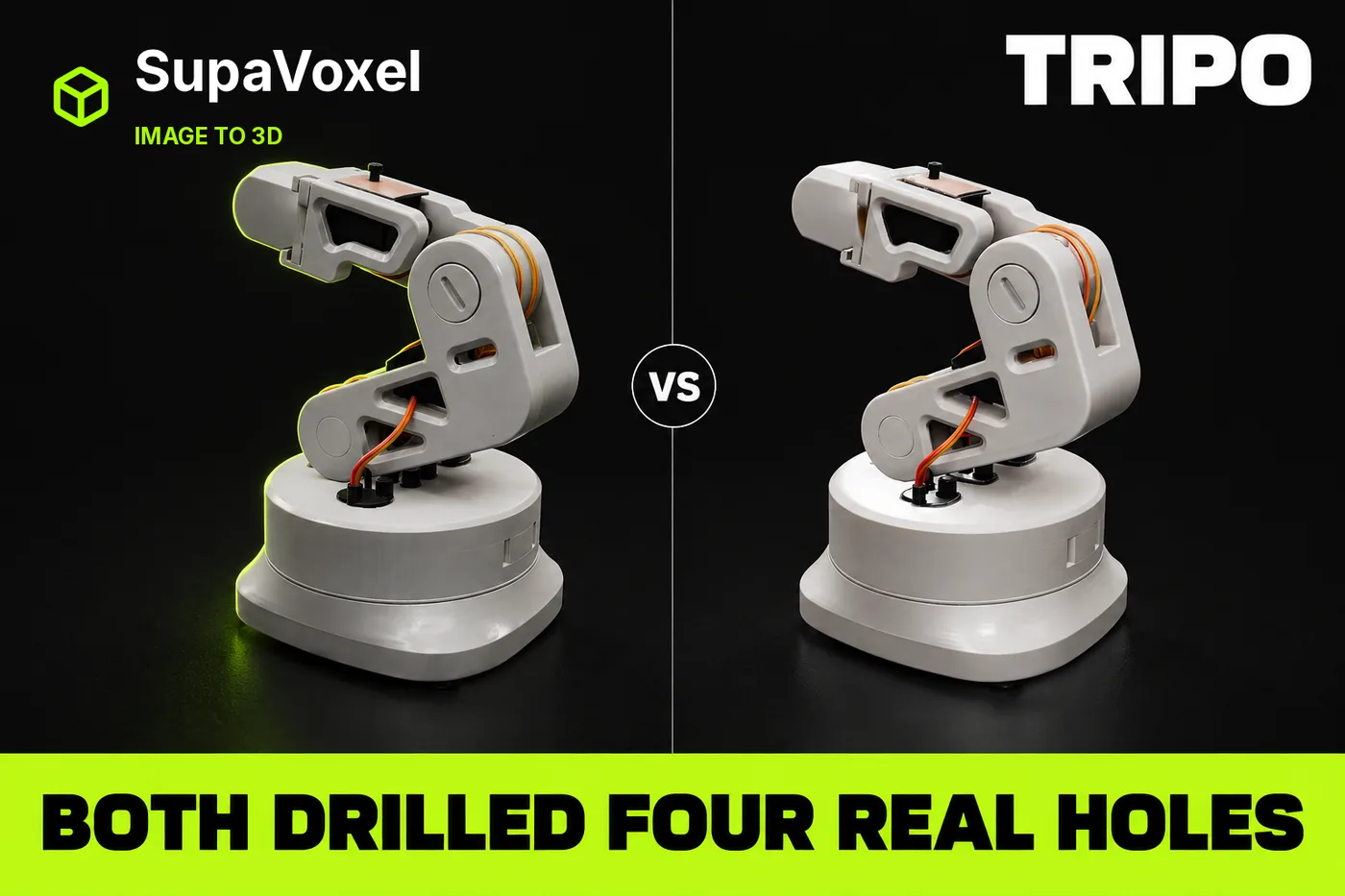
Disclosure: this is an independent hands-on test. Both tools were run on ordinary customer accounts; neither company supplied review access or saw this piece before publication.
My verdict in 60 seconds — Tripo 64/100, SupaVoxel 89/100
One photograph of a small white desktop robotic arm — two flat link plates with cut-out windows, and a three-strand servo cable running from base to wrist — put once through Tripo and once through SupaVoxel at stock defaults, then both GLB files torn apart offline by the same script. I paid for both runs myself and I have no stake in either tool. This is the one test in my series where both products passed every part of the geometry stress axis. Tripo did not fake a hole, flatten the cable or fatten the plates. Neither did SupaVoxel. So the question is not who failed — it is what Tripo charges for a result that ties.
- Through-holes — Tripo 4 fully enclosed openings from the front · SupaVoxel 4 · both real, neither faked with texture; SupaVoxel's are ~15% larger in area (149.56 / 149.50 mm² against 132.31 / 128.69 mm²)
- Thin cable — Tripo raised geometry · SupaVoxel raised geometry · both still standing with every texture stripped off
- Link plates — Tripo median 1.668 mm · SupaVoxel 1.721 mm · both flat, parallel-sided, ≈4 extrusion widths at 0.4 mm
- Winding consistency — Tripo inconsistent · SupaVoxel consistent · the Tripo file has to be flipped before it slices
- Non-manifold edges / shells — Tripo 8 / 8 · SupaVoxel 148 / 100 · Tripo wins both rows clearly; the SupaVoxel mesh needs a merge pass
- Support area at 120 mm — Tripo 6,761.4 mm² (16.50%) · SupaVoxel 4,858.5 mm² (12.01%) · 28.1% less to cut off the SupaVoxel print
- Mean edge at 120 mm — Tripo 0.2326 mm · SupaVoxel 0.3335 mm · Tripo 1.43× finer, and a 0.4 mm nozzle cannot use it
- Resin at 120 mm — Tripo 250.53 cm³ / $8.77 · SupaVoxel 232.74 cm³ / $8.15 · $0.62 apart
- Cost of the tie — Tripo 55 credits · SupaVoxel 3 credits · 18.3×
Three things before the detail. Tripo is genuinely good on this subject and I will not pretend otherwise — on a clean, evenly lit, hard-surface object, Tripo resolves what is in the photo. Tripo hands you inconsistent winding, so every Tripo file in a batch needs its normals flipped; SupaVoxel hands you 100 shells, so every SupaVoxel file needs a merge. Neither is drop-in. And Tripo spent 1,954,511 triangles and 62.89 MB to reach the same three verdicts SupaVoxel reached with 997,355 and 5.63 MB.
For printing this arm at 120 mm I would use the SupaVoxel file — not because Tripo failed, but because the repair I would rather own is the scriptable merge, on the file that costs 3 credits instead of 55.
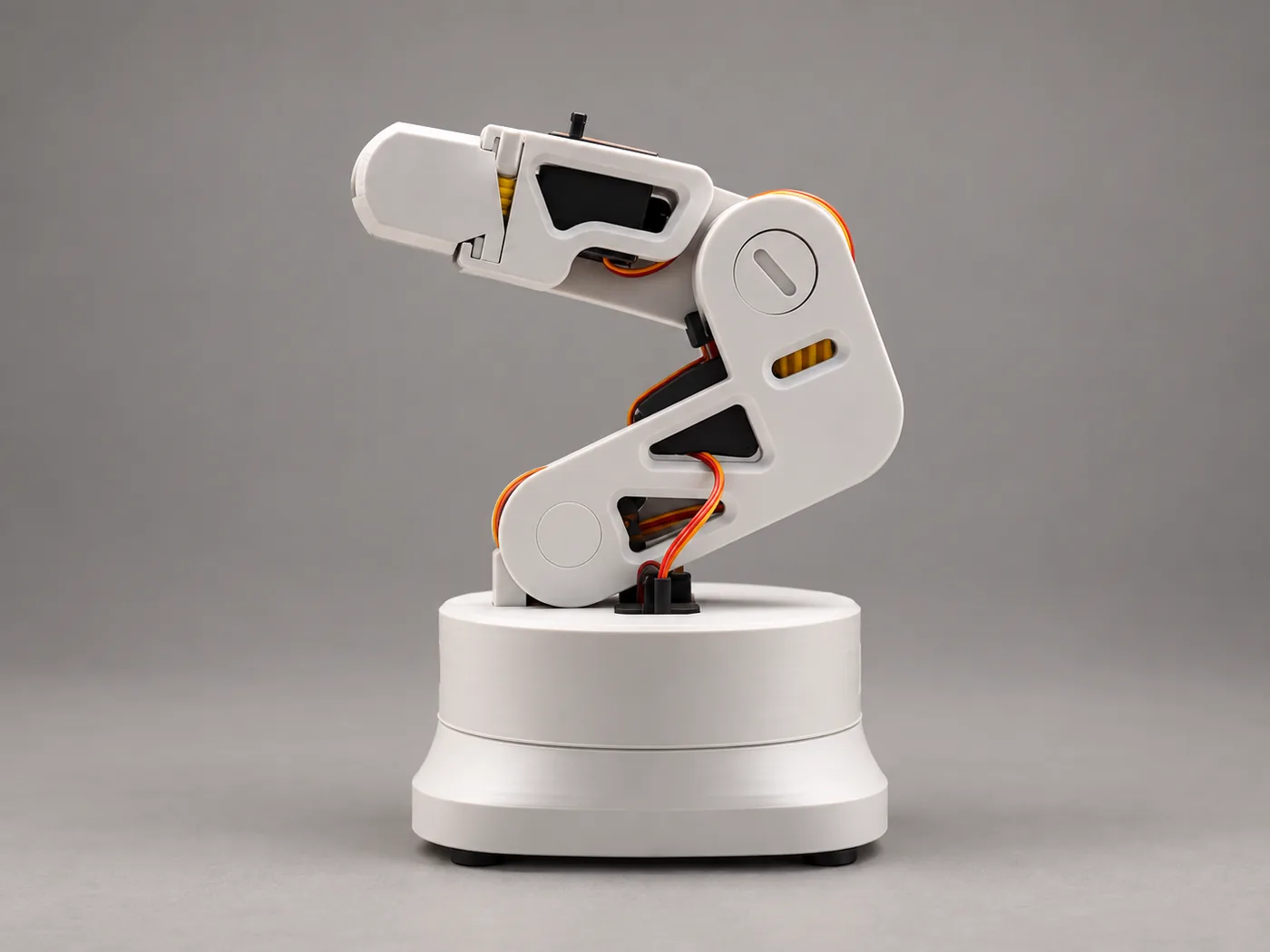 The single input, 1,403,490 bytes, sha256 3a7af565…. Two flat link plates, a triangular window on the lower one, a rounded-rectangle window plus a narrow slot on the upper one, an orange/red/yellow servo loom climbing to the wrist. One side only. Both products got this file byte for byte.
The test: three things that kill a cheap pipeline
I picked this subject for three failure modes a weak image-to-3D pipeline gets wrong in three different ways: a hollow window painted on as a dark patch instead of drilled, a thin cable smeared into the body, a flat plate inflated into a lozenge with no parallel faces.
Every printability figure below is measured after merging vertices by position — both exports split vertices along UV seams, and unwelded you are measuring texture seams and calling them holes. I scaled both meshes to a target height of 120.0 mm and assumed a 0.4 mm nozzle.
Window test: Tripo drilled four real holes, and so did SupaVoxel
The method is a parallel ray grid at 0.25 mm per pixel, fired from eight horizontal directions, counting only "miss islands" completely surrounded by hit region. A window painted on as dark texture, or modelled as a blind recess, can never produce an island.
From the front, Tripo produces four fully enclosed openings. SupaVoxel produces four. Tripo's two largest measure 132.31 mm² and 128.69 mm²; SupaVoxel's measure 149.56 mm² and 149.50 mm². Tripo's windows are real, and Tripo's frames are thicker — its openings are roughly 15% smaller in area, a shade further from the reference photo, not a defect.
The welded topology of the SupaVoxel mesh corroborates the count independently: Euler characteristic +30, total genus 85, and only 2 boundary edges, so those islands are genuine tunnels rather than artefacts of an open surface. Second-order number: the four holes cost 55 credits on Tripo and 3 on SupaVoxel.
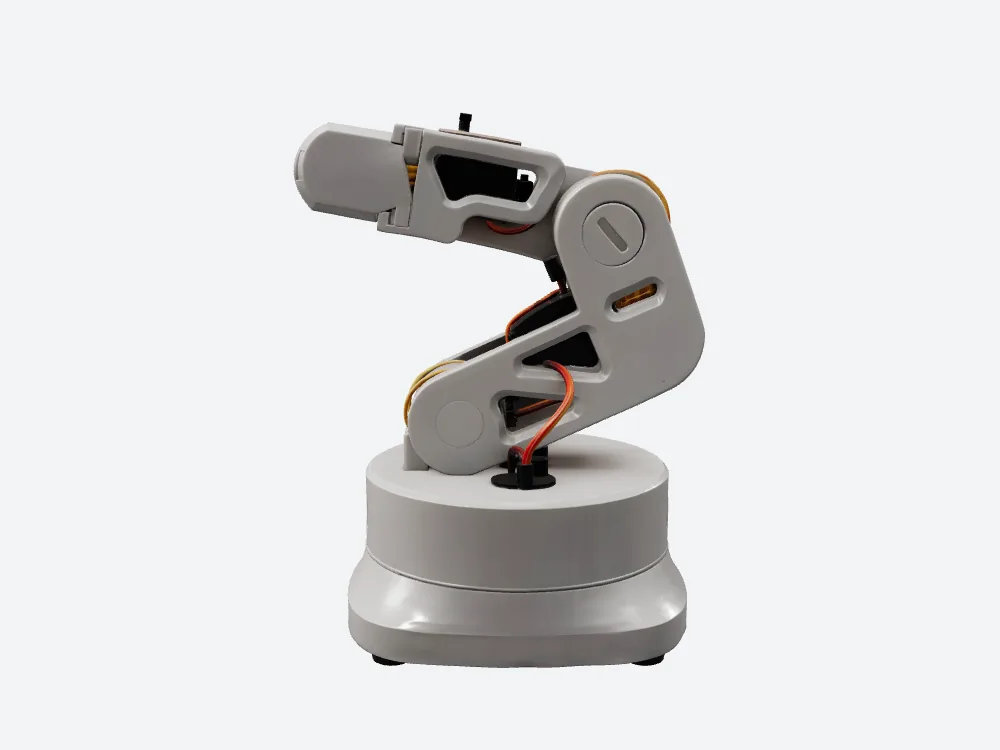 SupaVoxel, front. Both windows read as openings, not dark patches. The loom climbs from a black base connector to the elbow, reading here as one thicker tube.
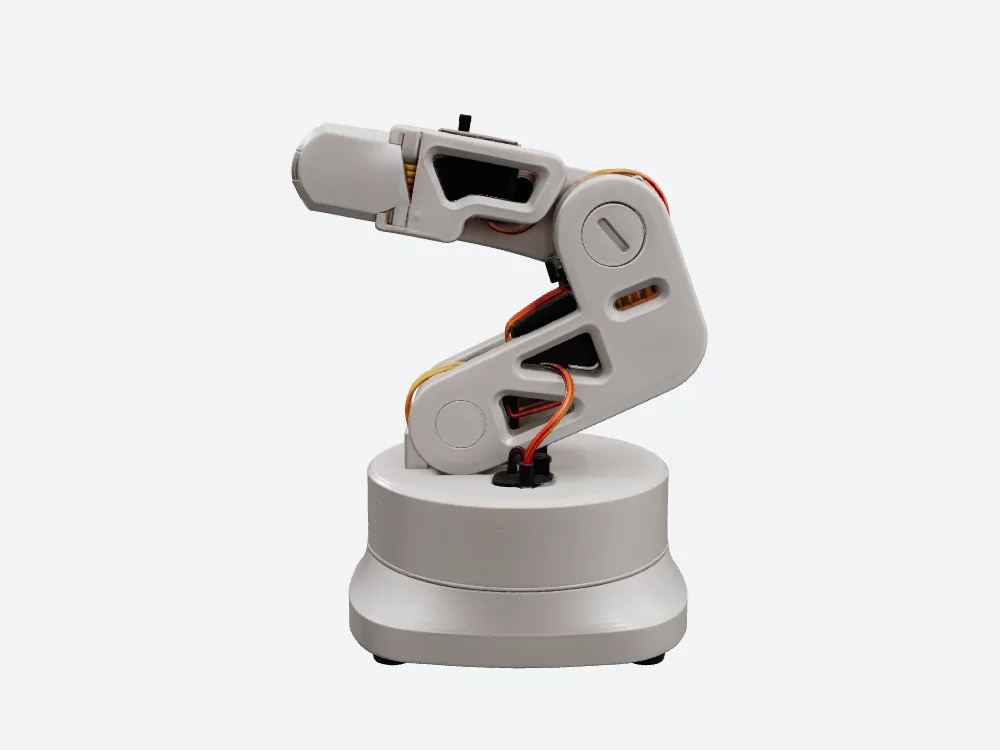 Tripo at the identical camera. Composition matches almost exactly; Tripo's window frames sit visibly heavier, and Tripo baked a yellow transverse texture into the upper slot where SupaVoxel's is bare.
The side view is the cheapest proof either product could offer
Looking down the thin edge of the link plates, the rounded-rectangle window shows the dark cavity behind it on both models, with two cable runs passing vertically through the opening. Tripo's opening sits lower and narrower; both frames are continuous and closed. One difference nobody can grade: the base's top face carries four black connector posts on the SupaVoxel model and three on Tripo's, and the photograph does not show that surface.
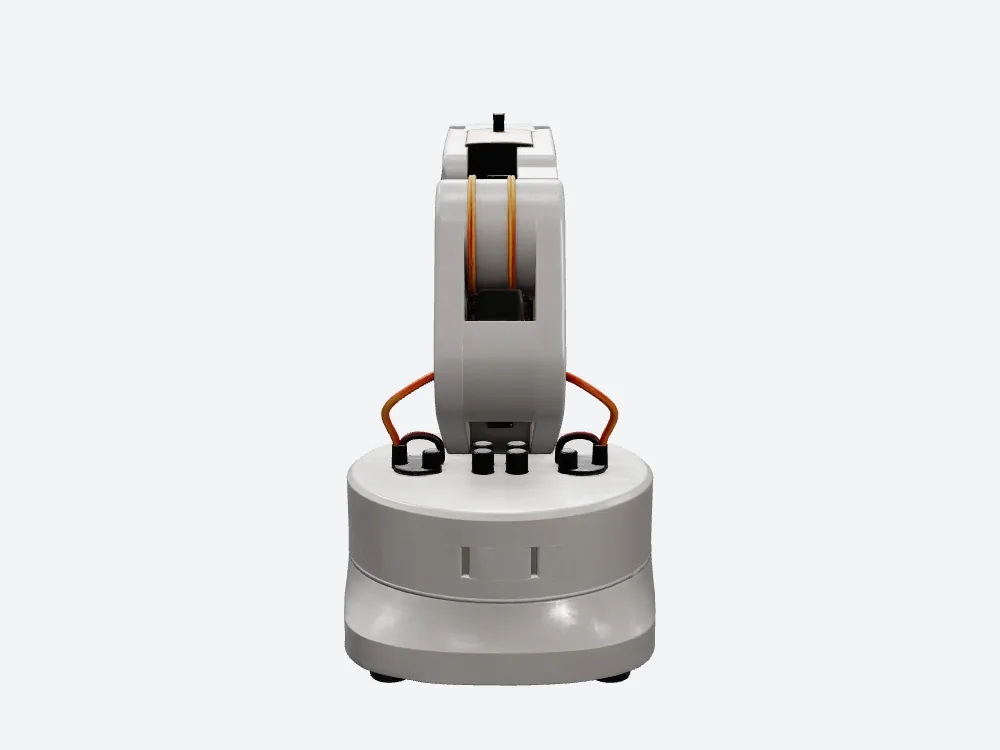 SupaVoxel, side. The window is fully open to the cavity, the frame an unbroken white rim, two orange runs arching onto the base connectors.
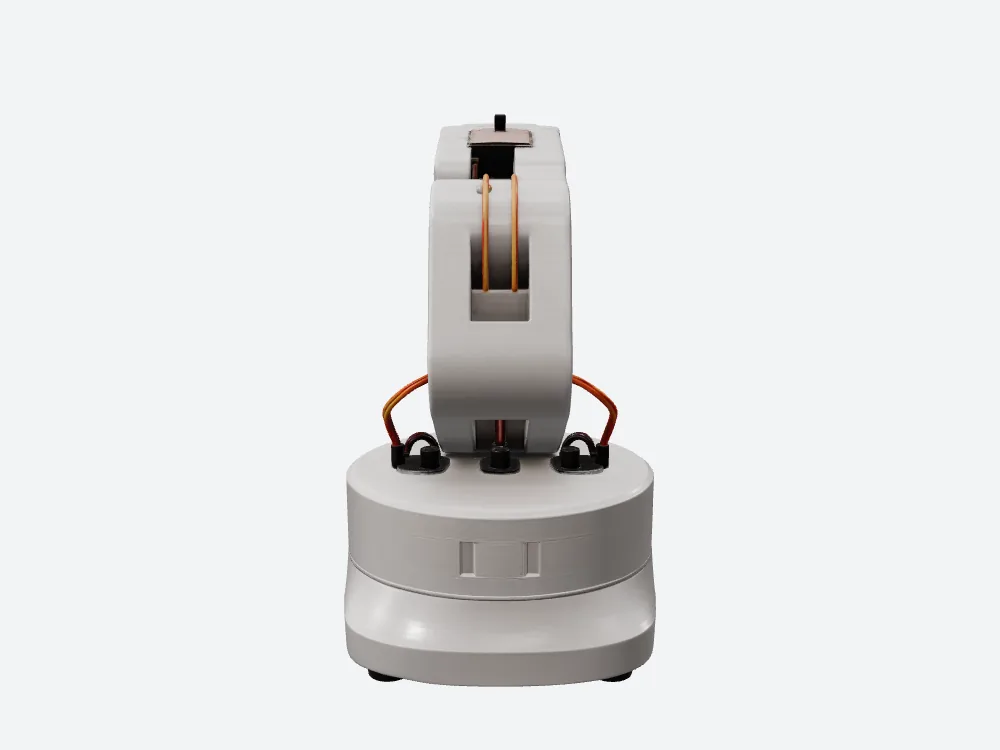 Tripo, same camera. Also fully open, placed lower and narrower, cables crossing it orange-brown. Three base posts against SupaVoxel's four — both invented.
Strip the textures and Tripo's cable is still standing
This is the hardest evidence in the case and it goes to both products. With every texture removed, the windows on both meshes are still black holes and the cable on both is still a raised tube leaving the body. Neither Tripo nor SupaVoxel painted a feature it did not build.
The measurement behind that: sample vertex baseColor through the UVs, isolate the orange/red cluster, then measure each orange vertex's distance to the nearest non-orange vertex. A painted-on stripe scores near zero. Tripo's cable peaks at 4.158 mm of standoff (p90 1.670 mm); SupaVoxel's peaks at 10.337 mm (p90 4.551 mm), 2.49×. The SupaVoxel loom genuinely bridges open air over the triangular window; Tripo's hugs the body.
For a printer that is not automatically a SupaVoxel win. A 10.337 mm unsupported span of thin tube needs support or a bridge; Tripo's 4.158 mm is easier to lay down. Tripo wins the printability of the cable run.
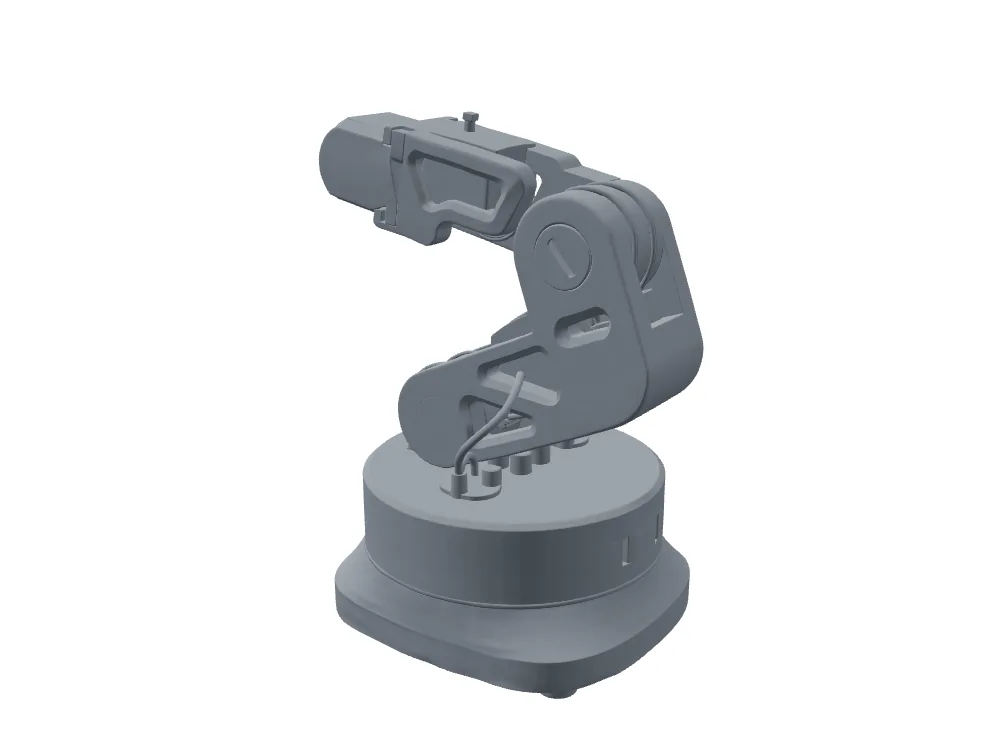 SupaVoxel, textures off. Windows still black openings, cable still a tube standing off the chassis with a clearly airborne section.
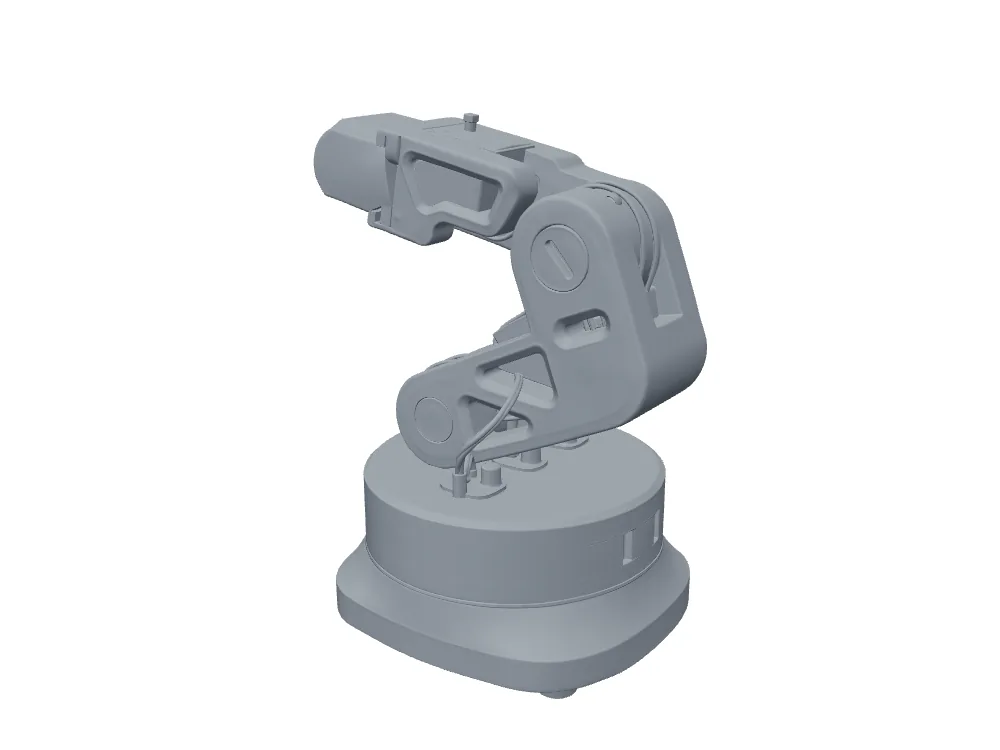 Tripo, textures off, same camera. Windows and cable all present — no texture cheating on either side. Tripo's loom is several fine parallel ridges where SupaVoxel's is one thick ridge; at 0.4 mm neither survives.
Plate thickness: both flat, SupaVoxel more consistent
Face-to-face rays fired only at the link segment (the 45–118 mm band of the 120 mm model) give a bimodal thickness distribution — a thin-plate mode and a ~26 mm mode where the ray crosses the whole arm body. Only the sub-8 mm mode is the plate.
Tripo's plate median is 1.668 mm across 834 rays; SupaVoxel's is 1.721 mm across 866. The medians are effectively the same, and SupaVoxel's consistency is 1.51× better. At 0.4 mm that median is about 4.3 extrusion widths — two perimeters plus a little infill, the textbook printable plate. Neither product made a paper-thin fin, neither inflated it into a block.
- Plate median — Tripo 1.668 mm · SupaVoxel 1.721 mm · tie
- Plate IQR / std dev — Tripo 0.838 / 1.186 mm · SupaVoxel 0.554 / 0.763 mm · 1.51× more uniform
Where Tripo wins outright: 8 non-manifold edges against 148
This is the row SupaVoxel loses, and it loses it by a wide margin, so here it is unhedged. Welded, Tripo's mesh carries 8 non-manifold edges and 8 connected shells. SupaVoxel's carries 148 and 100 — 18.5× and 12.5×. The SupaVoxel file is assembled from many more fragments and needs one merge-and-clean pass before it slices as a solid: real work, scriptable for a batch, but not a checkbox.
What comes back the other way is consistent winding where Tripo is inconsistent, and 2 boundary edges where Tripo has 14 (unwelded, 48,367 against 85,447, 1.77×). Tripo's mesh has to be flipped and its open loops closed; SupaVoxel's has to be merged. Neither product ships something you can slice untouched. The exchange rate: that merge buys an 18.3× credit difference and an 11.18× file difference.
- Non-manifold edges / shells — Tripo 8 / 8 · SupaVoxel 148 / 100 · Tripo wins both
- Boundary edges (welded) — Tripo 14 · SupaVoxel 2 · SupaVoxel wins
- Winding — Tripo inconsistent · SupaVoxel consistent · SupaVoxel wins
- Euler characteristic — Tripo −73 · SupaVoxel +30 · watertight on neither
One row does go the other way. Slivers — the long, near-zero-area triangles that self-intersecting toolpaths come from — run 1,510 on Tripo's welded mesh against 233 on SupaVoxel's, 6.48×, with 0 degenerate faces on both. That does not cancel SupaVoxel's 148 non-manifold edges; they are different repairs, and on this subject Tripo's mesh hygiene is the better one overall.
Support area: 1,902.9 mm² less to cut off
At 120 mm and a 45° threshold, Tripo needs support on 6,761.4 mm² (16.50% of its surface) against SupaVoxel's 4,858.5 mm² (12.01%) — 1,902.9 mm² and 28.1% less, or 190,290 mm² less across a batch of 100.
Welded solid volume is 250.53 cm³ for Tripo against 232.74 cm³ for SupaVoxel, at $35/L $8.77 against $8.15 — $0.62 apart. Physically these are almost the same object, so whatever the extra 52 credits purchased, it did not become a millilitre of material on the build plate.
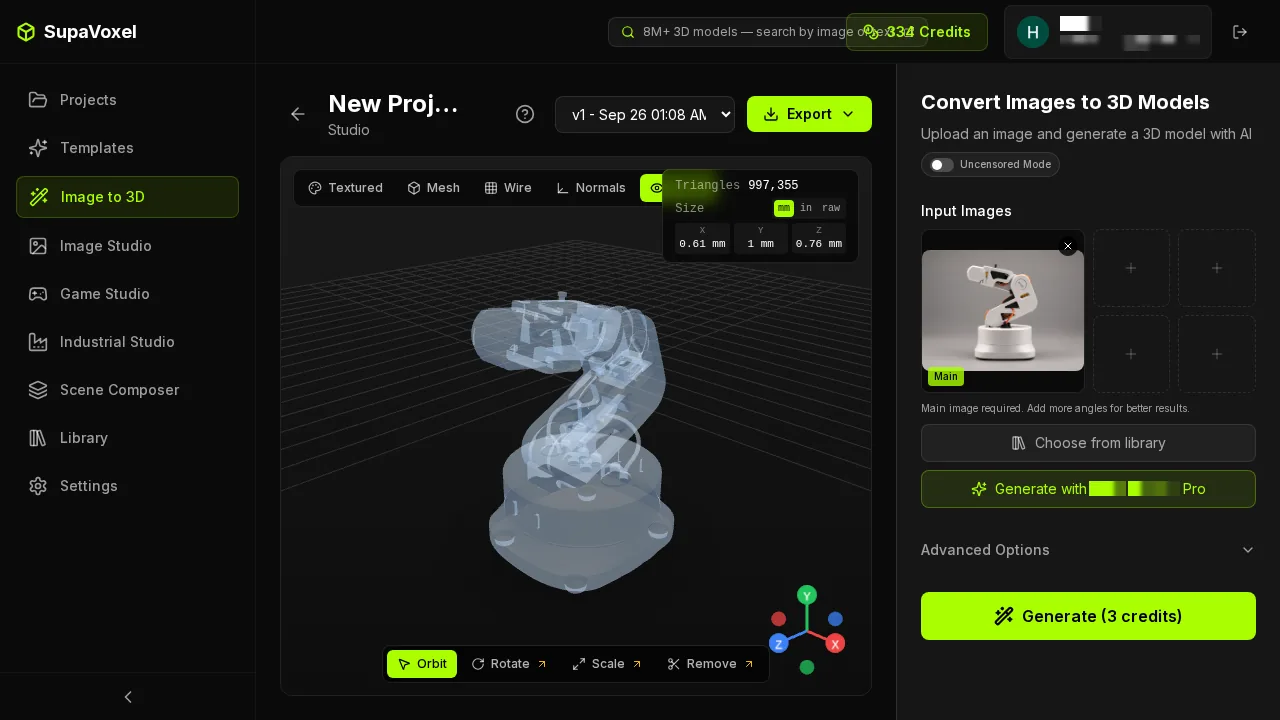 SupaVoxel's in-product X-Ray mode. Both windows stay empty in transparency and the frames read as closed loops — the same four openings the offline ray test counted, in one click.
Mean edge length: Tripo is 1.43× finer and your nozzle cannot tell
Tripo's mean triangle edge at target height is 0.2326 mm against SupaVoxel's 0.3335 mm. Tripo is 1.43× finer and that row belongs to Tripo — it just does not reach the part. A 0.4 mm nozzle sees Tripo's edge at 0.58× and SupaVoxel's at 0.83×, both already under the nozzle, so the slicer discards detail from both at the same rate. To cash it in you need SLA. On FDM the exchange rate is 1.43× edge fineness for 18.33× the credits and 11.18× the file.
Getting the file out: two clicks each, two dialogs to dismiss first
Click count ties: both products reach a file on disk in 2 steps. The path is not the same. SupaVoxel's Export is one toolbar dropdown opening onto everything at once — GLB, OBJ, STL, USDZ, 3MF, plus Copy URL, Fix Mesh, 3D Printing and Embed — on the same screen as the inspection modes, nothing to close first. Tripo's Export button sits in the bottom bar, and by the time you reach it you have dismissed two overlays: the View Your Model panel during generation, then a five-video Guide after completion.
Tripo's export dialog offers File Name, Format, and Texture Resolution pre-set to 4k (Current). I opened both dropdowns looking for more — there is nothing more. No triangle budget, no topology cleanup, no geometry-only option. That 4k default is where 62.89 MB comes from.
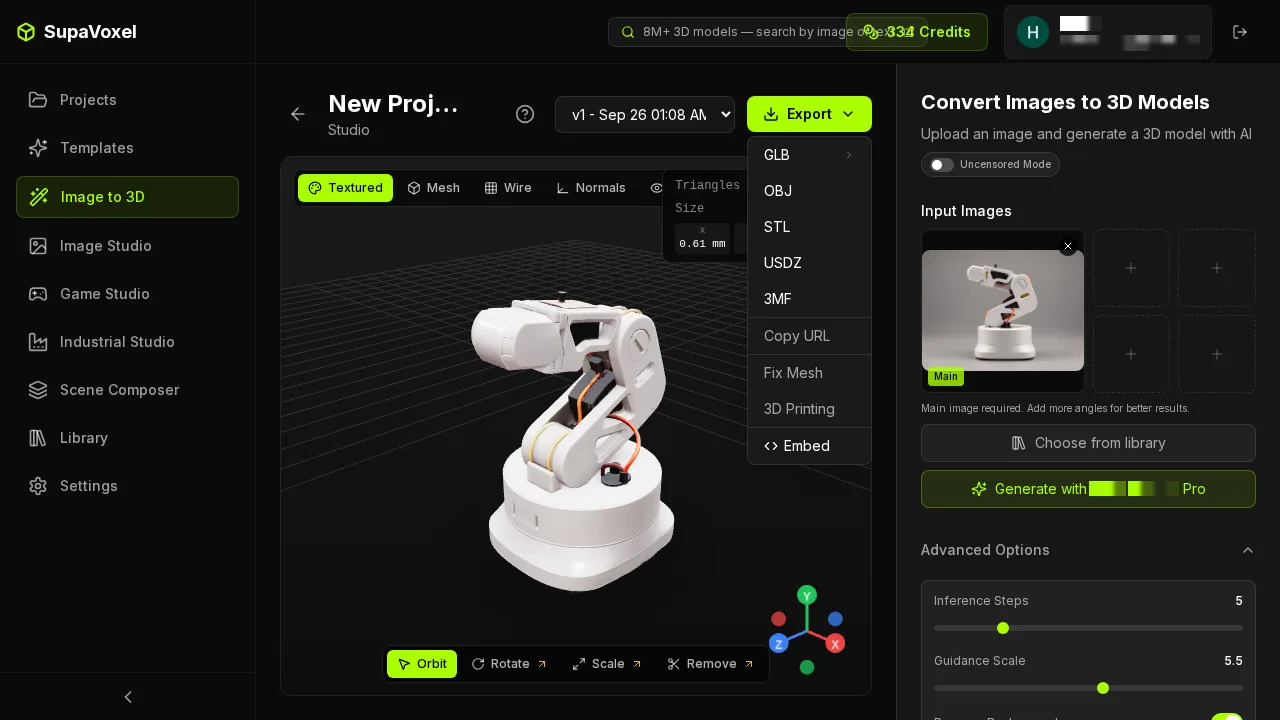 SupaVoxel's export dropdown: five formats plus Fix Mesh in one menu. With 148 non-manifold edges, that repair entry is not decoration.
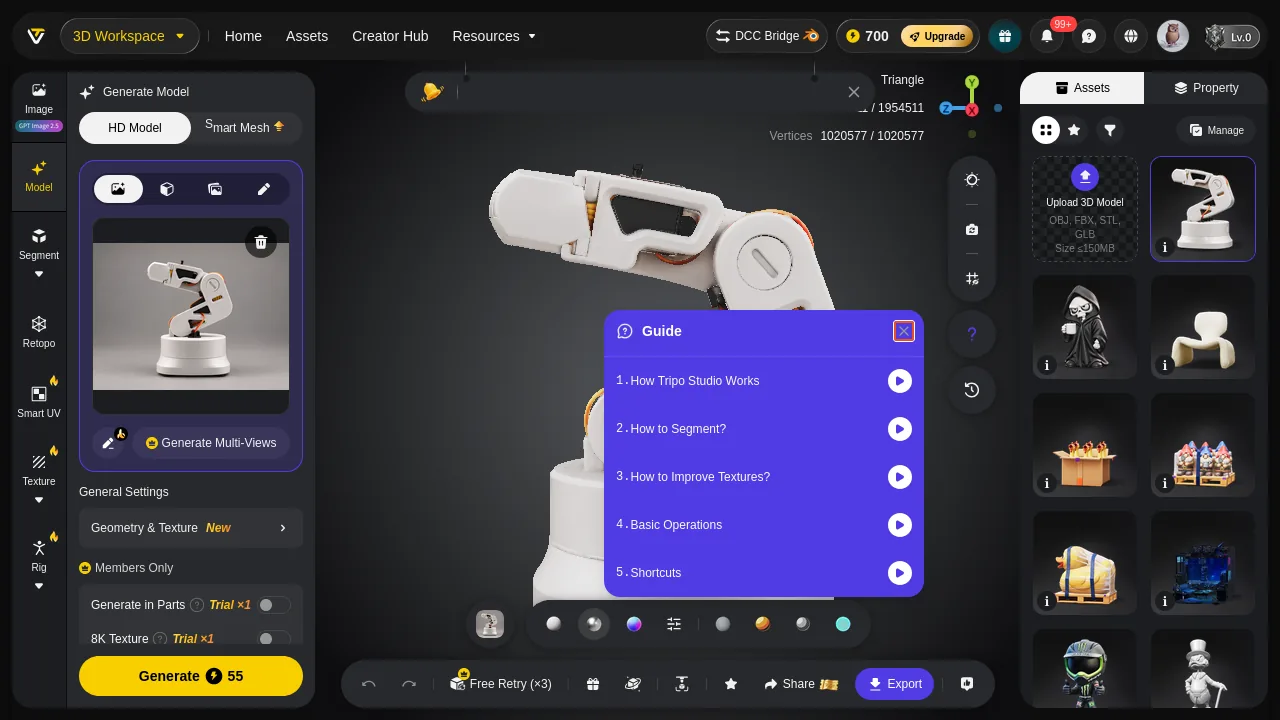 Tripo after generation: close one overlay, get another. The Guide panel's lower edge overlaps the Export button in the bottom bar.
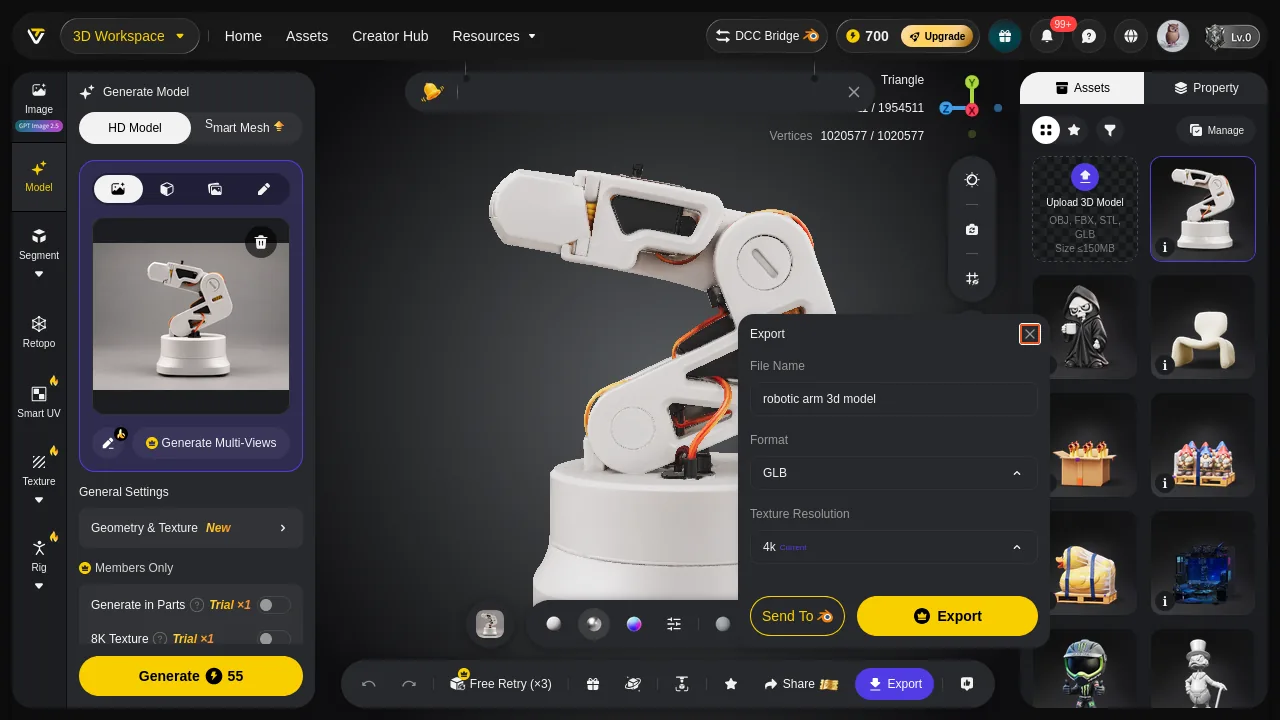 Tripo's export dialog. Three fields, Texture Resolution on 4k (Current), no warning that most of those bytes never reach the print.
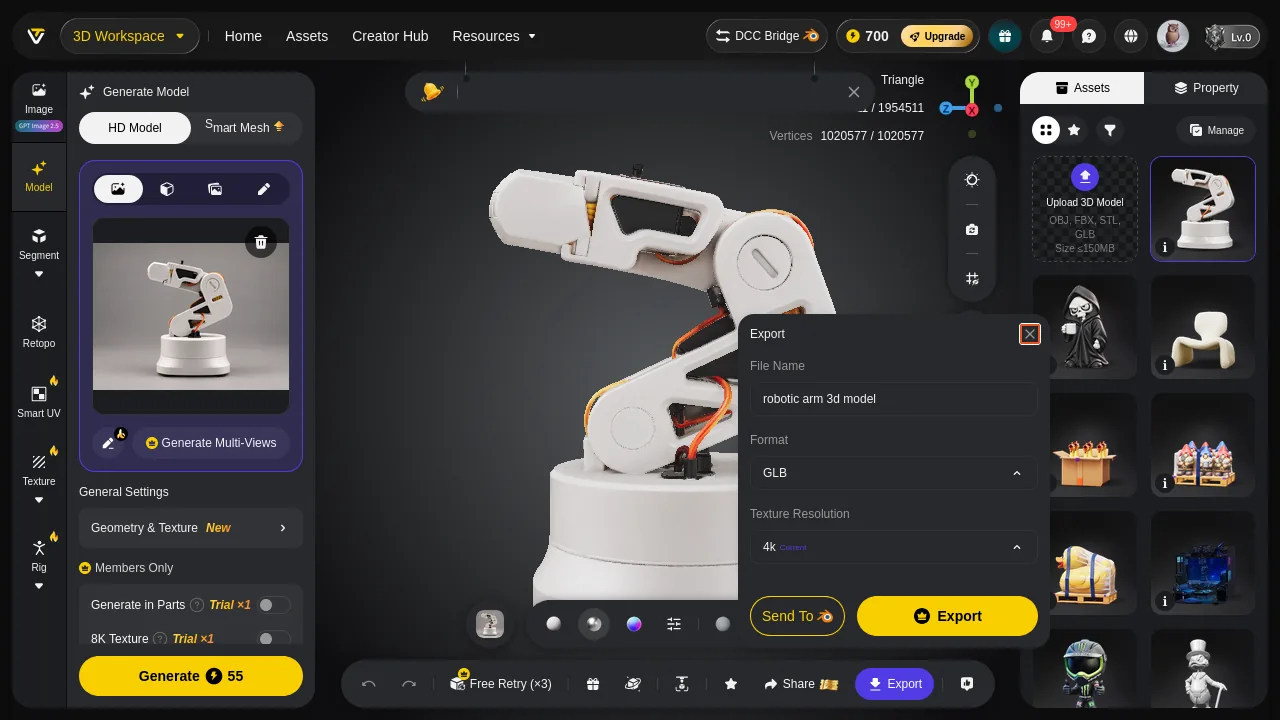 The same Tripo dialog with both dropdowns engaged — identical fields. Format and texture resolution are the whole control surface.
Final verdict: Tripo scores 64/100 on this build
Tripo's extra 957,156 triangles bought a mean edge a 0.4 mm nozzle cannot use, a cable run that prints more easily, cleaner shell structure and 1,277 extra slivers. They did not buy a hole SupaVoxel failed to drill, a cable SupaVoxel failed to build, a millilitre of resin, or a square millimetre less support.
Tripo passes the stress axis outright and beats SupaVoxel on shell structure and on the cable's printability. That is a real result and I am scoring it as one. Tripo then asks 55 credits for it, ships inconsistent winding that must be flipped on every file, asks for 39.2% more support area, and puts 62.89 MB on your disk. SupaVoxel scores 89/100: the same three passes, larger openings, more uniform plates, consistent normals, 2 boundary edges, 28.1% less support, 3 credits — against one honest debt, a 100-shell mesh to merge.
The conclusion here is not a defeat for Tripo. It is that on an easy, well-lit, hard-surface subject the two products converge — so what separates them is price, and what happens on harder subjects.
Which one I would use for this job
Same photograph, 3 credits, 5.63 MB, consistent winding, 2 boundary edges, 12.01% support area, five export formats and a mesh repair entry in the same menu — supavoxel.com. Bring your own reference and look at the untextured mesh first; that is where this comparison was decided, and on this subject it decided in favour of both.
Originally published on Medium: Tripo AI Robotic Arm Review 2026: 55 Credits, Same Four Holes.