For readers considering hyper3d for a textured vase, this hands-on comparison examines the downloaded mesh alongside SupaVoxel's. It distinguishes a repair-friendly shell from pronounced knitted cable relief without claiming either vase has been printed or tested with water.
Disclosure: this is an independent hands-on test. Both tools were run on ordinary customer accounts; neither company supplied review access or saw this piece before publication.
I wanted a vase whose thick knitted cables were there when the material was switched off. Not chevrons painted on a smooth pot: actual strands passing over one another. I gave Hyper3D and SupaVoxel the same image and took apart the downloaded meshes. Then I looked down the mouths. That second view made it impossible to mistake “vase-shaped” for “ready to hold flowers.”
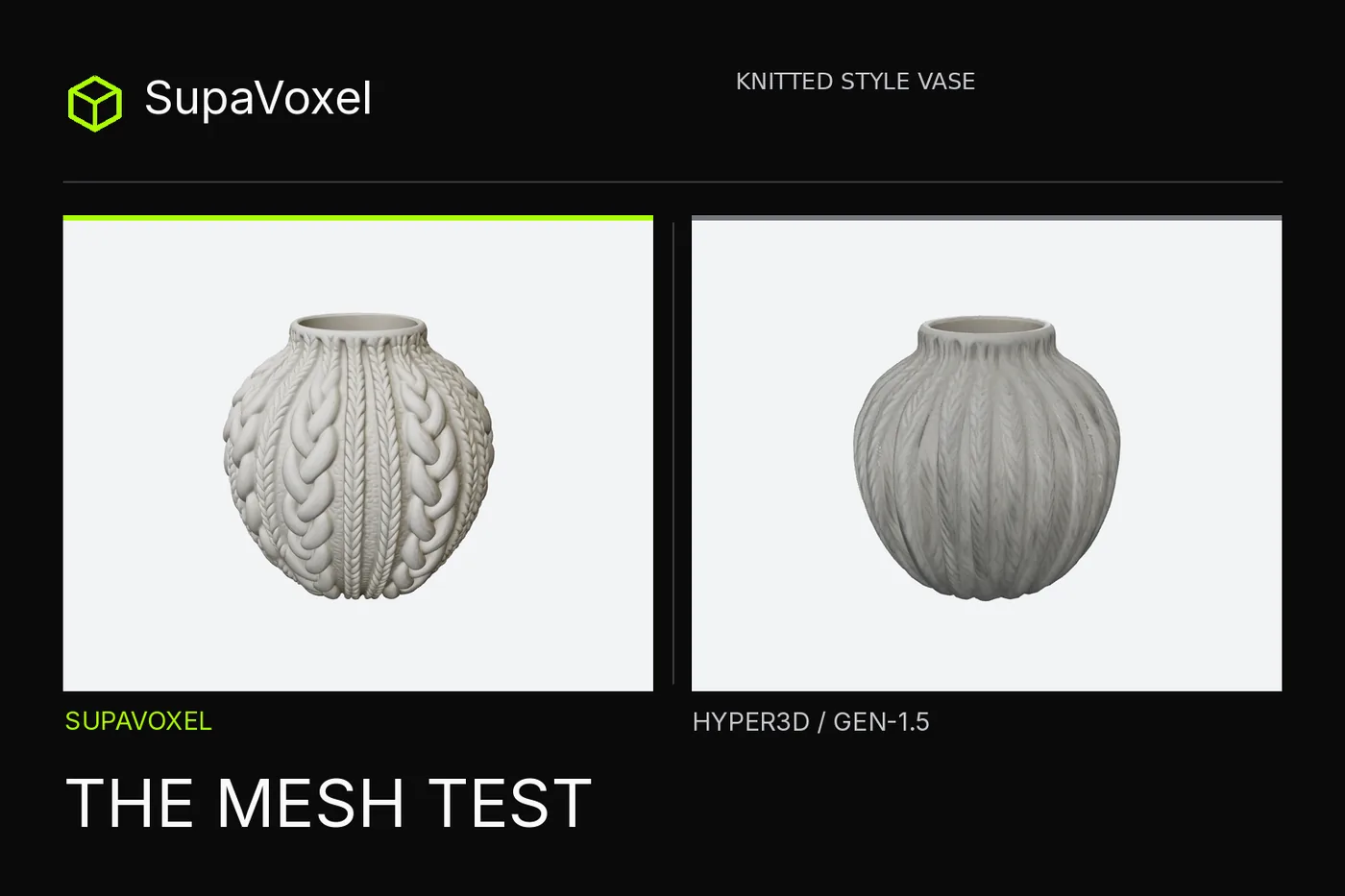
My verdict in 60 seconds — Hyper3D Gen-1.5 has the cleaner starting solid, but SupaVoxel is the stronger knitted design. Hyper3D's downloaded model becomes one watertight face-connected shell with zero non-manifold edges after UV welding, while the SupaVoxel export keeps the photographed raised cable crossings but has 744 non-manifold edges and 497 face-edge-connected regions. If a file must go first to mesh repair and then slicing, I would inspect the Hyper3D shell first. If the brief is to preserve big physical-looking knit relief in a digital concept, I would start with SupaVoxel and repair it. Both cavities are shallow; neither has been printed, filled or proved to hold water.
Eight side-by-side checks, Hyper3D then SupaVoxel:
- Rounded-vase silhouette — both retain mouth and belly; SupaVoxel shows fuller raised knit.
- Raised cable crossings — the downloadable Hyper3D Gen-1.5 file simplifies them into ribs; SupaVoxel keeps over-and-under geometry without maps.
- Watertight after UV seam welding — Hyper3D yes; SupaVoxel no, despite zero boundary edges.
- Non-manifold edges — Hyper3D zero; SupaVoxel 744, not a solved slicer problem.
- Face-edge-connected integrity — Hyper3D one shell versus SupaVoxel 497 regions after welding; the latter still forms one vertex-connected cluster.
- Modeled cavity — Hyper3D 32.79–35.13 mm versus SupaVoxel 22.8–24.0 mm at 120 mm longest-side scale; both are shallow.
- Slender-face hygiene — Hyper3D 1,416 slender triangles versus SupaVoxel just 17; both have zero degenerates.
- Potential downward-facing surface — Hyper3D 4,655.3 versus SupaVoxel 5,704.4 mm² at one Y-up orientation; no support bill follows.
The decision changes with the intended use. Neither file is a measured physical vase.
Did the picture ask for real interwoven cables?
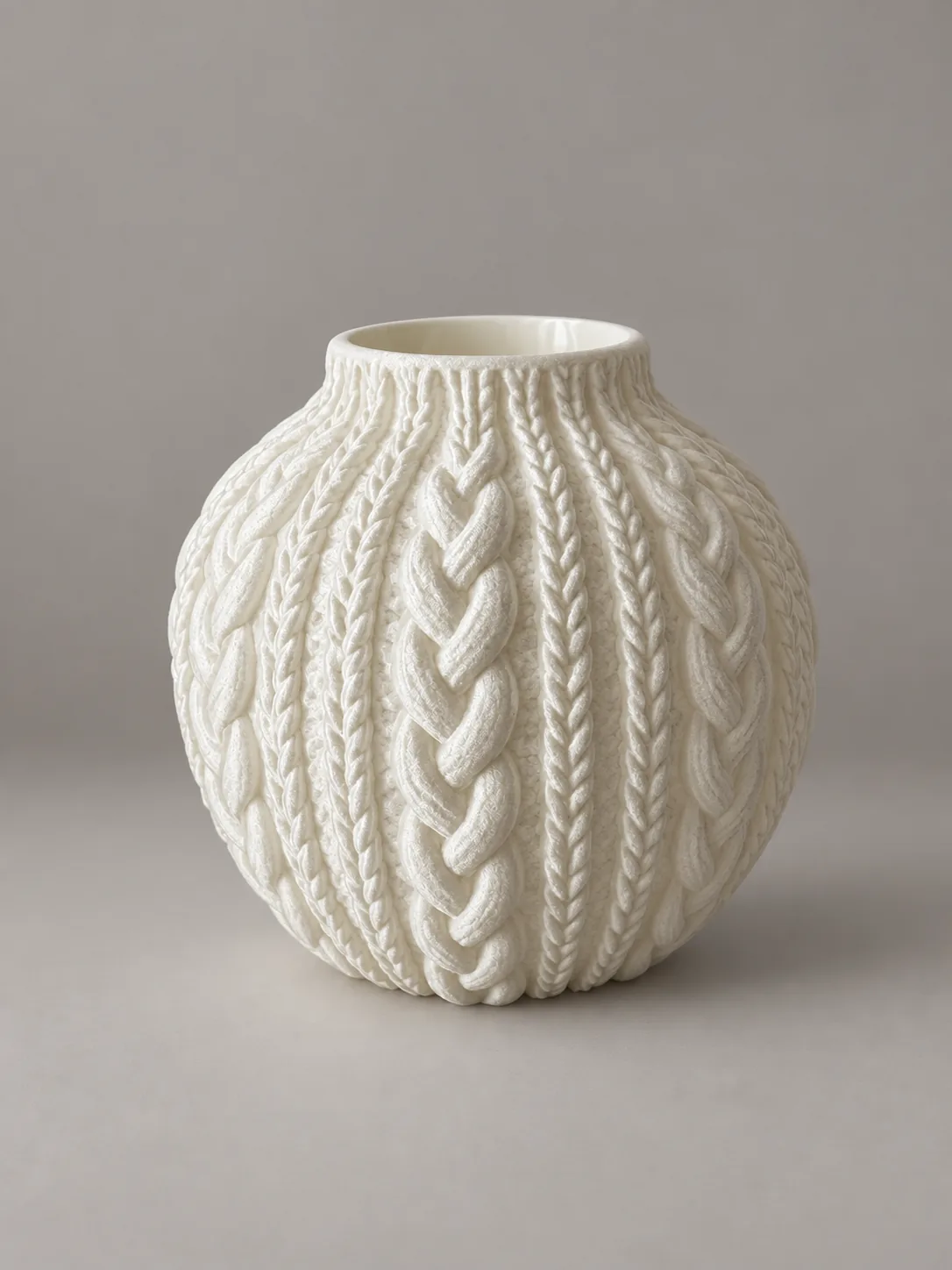
The same 1,746,019-byte generated PNG entered each product; the broad strands visibly cross, but the image supplies no dimensioned cavity or rear view.
Yes. The white source has thick, oversized knitted strands wrapping a round body. A strand running across another is a shape question before it is a color question. Both vendors got the exact SHA-checked input bytes, though no claim is made about identical internal image processing. Hyper3D offered a Gen-2.5 preview with larger crossings, but the tested Free account could not download it. The 60,000-triangle Gen-1.5 PBR file is the Hyper3D deliverable I measured against SupaVoxel's 971,714-triangle exported file. Those are separate workflows, not an export toggle on the same mesh. The input was made with a third-party cover as visual inspiration; this test does not establish rights to republish that underlying cover.
What did Hyper3D put in the downloadable shape?
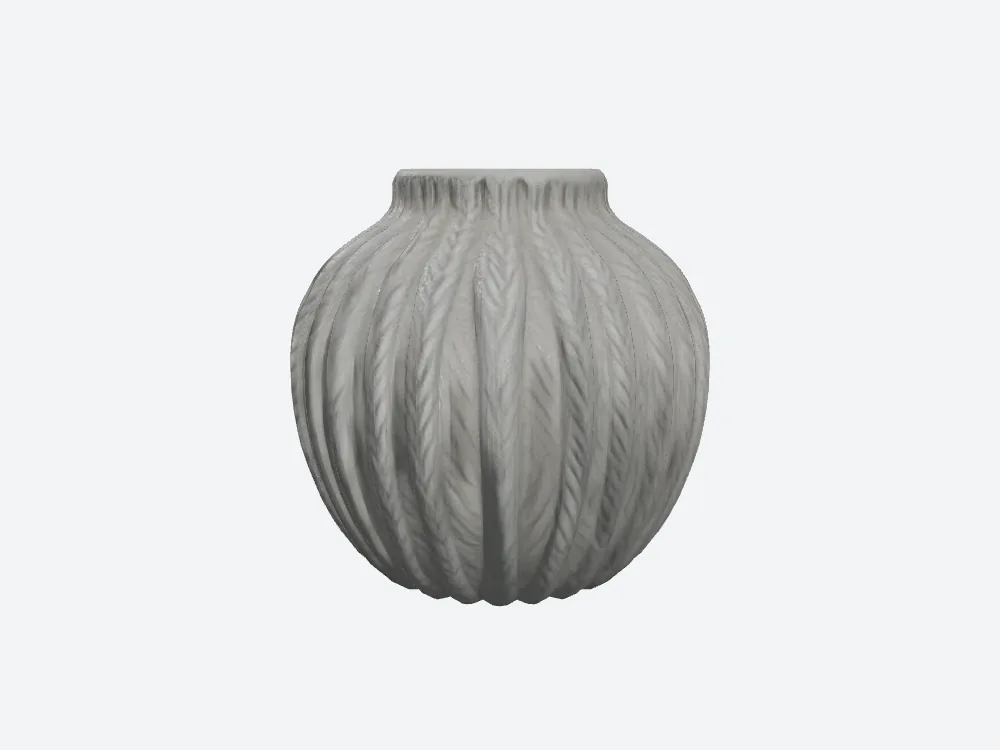
Hyper3D Gen-1.5 front: narrow mouth and recognizable rounded vase, but mostly vertical ribs rather than the source's bold crossings.
From a distance, this is an attractive ribbed pot. Move in, and the strands from the photograph largely stop passing over one another. Fine diagonal stitches appear in the material, but the main downloaded geometry resolves into regular longitudinal ribs. The file contains 60,000 triangles and 59,614 raw vertices; the interface displayed 60,000 and 59,765 respectively, so I use the exported accessors for counts. This is not evidence that Hyper3D can never make cable relief—only that its accessible Gen-1.5 export did not preserve the defining large over-and-under form in this one image. If that motif is the commission, somebody would have to sculpt it back in, and I did not time that labor.
Do the crossings survive a clay render?
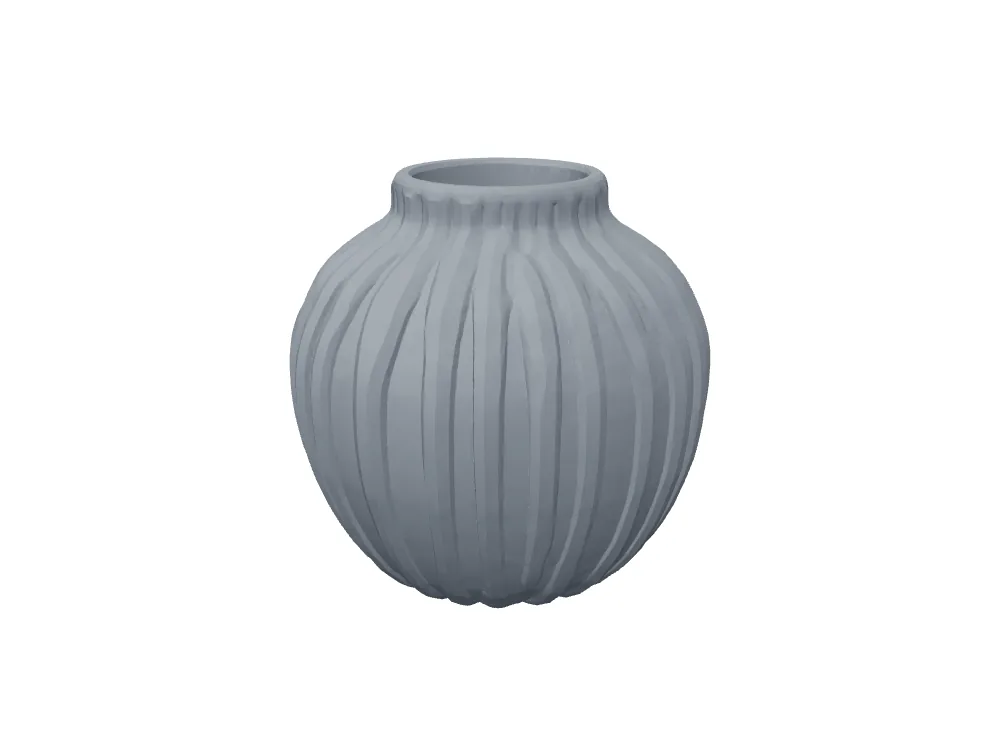
Remove color and normal maps: Hyper3D's raised longitudinal ribs remain, but most bold interweaving does not materialize.
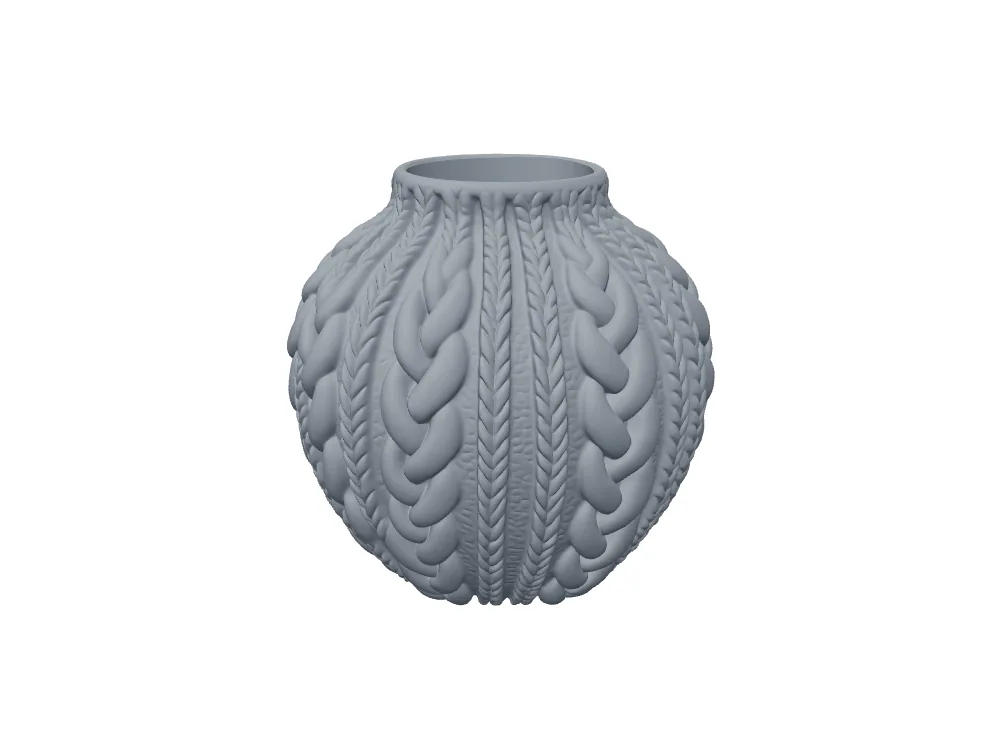
Same no-texture view on SupaVoxel: thick cables still visibly travel over and under one another. Topology repair is a separate issue.
This is where SupaVoxel wins the design task. A bump suggested by a normal map changes lighting; a real mesh crossing can cast, silhouette and be inspected as geometry. The SupaVoxel file keeps the large bends in the unpainted view. I did not measure their relief depth in millimeters, and the extra 911,714 triangles do not by themselves prove greater likeness. The location of the triangles matters: SupaVoxel uses its mesh to make the source's big feature visible without material. If my deliverable were a digital sculpture to show a knit pattern, I would accept the larger file and make repair a separate task rather than settle for the Hyper3D ribbed substitute.
What happened when I welded the UV seams?
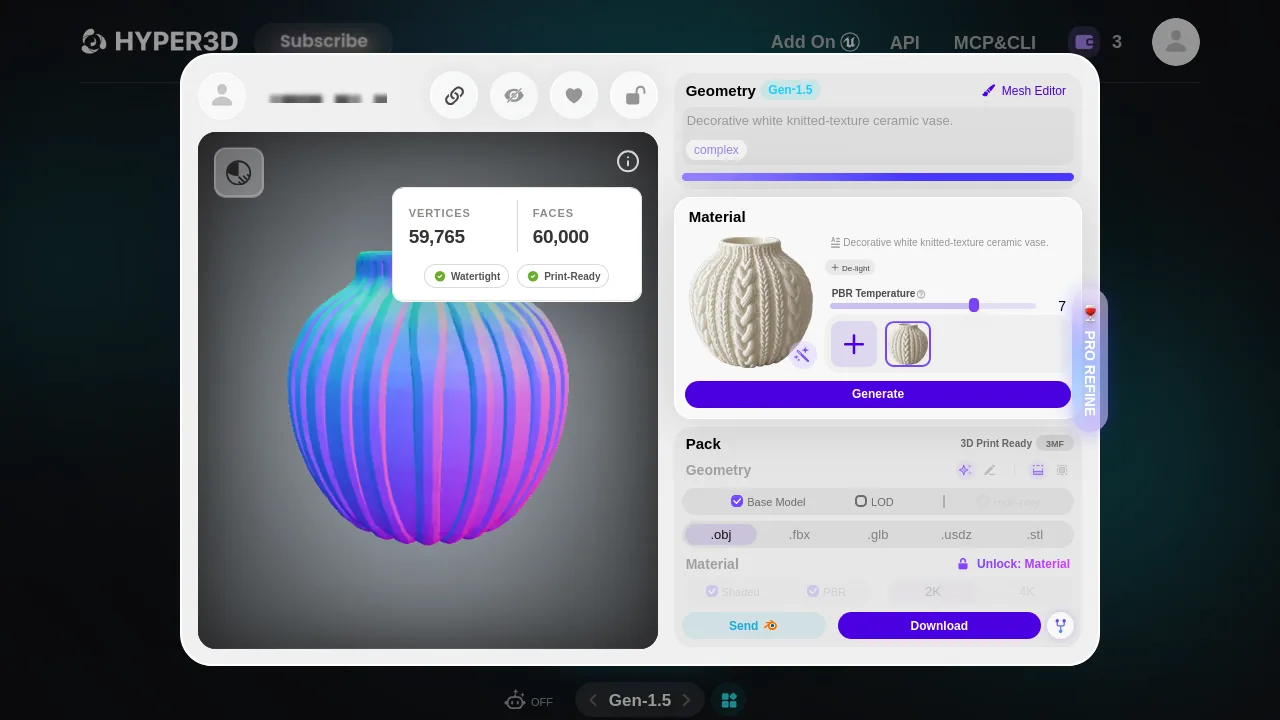
Hyper3D shows a Print-Ready label and 60,000 faces. The downloaded mesh, not the label, supplies the checks below.
Raw GLBs duplicate vertices across texture coordinates. Before welding, Hyper3D seemed to expose 49,964 boundary edges; treating UV splits as real holes would be wrong. Once coincident positions were merged independently of UVs/normals, Hyper3D's downloaded Gen-1.5 vase had one face-edge-connected shell, consistent winding, zero boundary edges and zero non-manifold edges, and was watertight. The raw vertex count went from 59,614 to 30,002 welded positions. These are unusually reassuring file checks for a print candidate, not an actual slicing, leak or load test. A closed shell can still be too solid in the wrong places, as the mouth sections show next.
Why is SupaVoxel's more faithful knit not print-ready?
After the same seam-weld method, SupaVoxel retains 744 non-manifold edges and fails watertightness. It yields 497 face-edge-connected regions. Important nuance: these are not 497 loose vases floating in space; at least one welded vertex connects those regions into one vertex-connected cluster. That distinction does not solve the manifold defect. Zero boundary edges and consistent winding coexist with the 744 problematic shared-edge junctions. I would not send this as an approved solid print simply because its renderer shows a coherent shape. SupaVoxel's menu offers Fix Mesh, but I did not run it; no repaired GLB, cleanup duration or proof of slicer acceptance is in this test. For a digital concept the knit wins; for an unchanged solid export the topology loses.
How deep is Hyper3D's apparently open vessel?
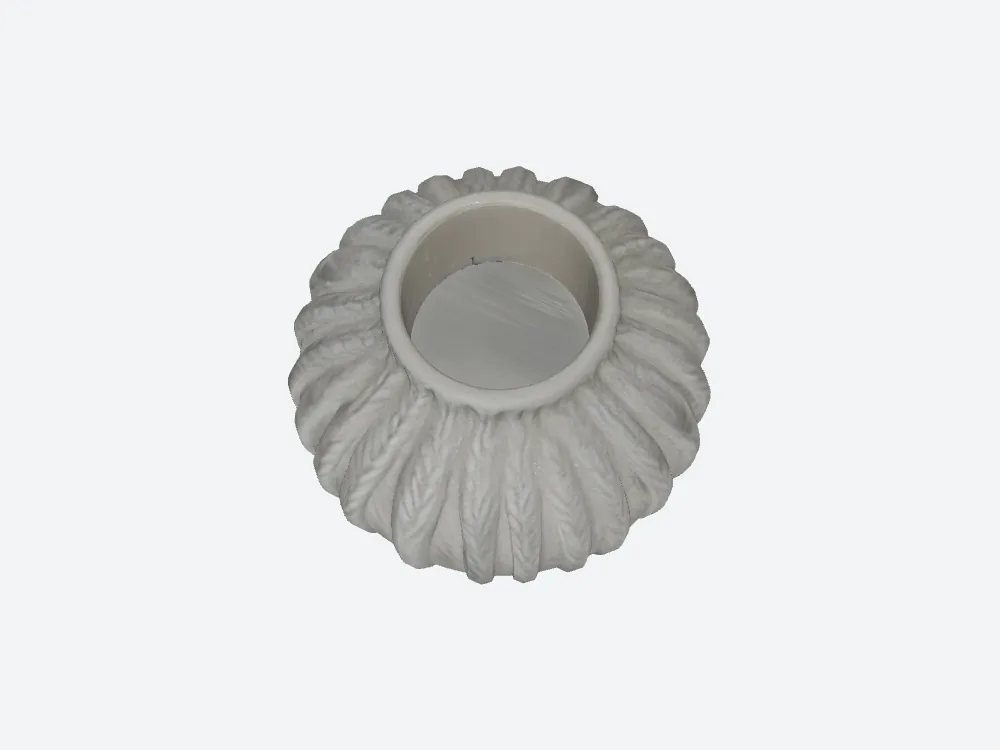
An actual mouth with a visible floor, not a view into a hollow lower belly.
I cut horizontal sections along the actual Y-up axis. When the file's longest bounding-box edge, not necessarily its height, is normalized to 120 mm, Hyper3D is about 117.11 mm tall. At 20%, 40%, 60%, 65% and 70% of that height, sections show one outer contour and no inner contour. A second inner loop appears between 70% and 72%, bracketing the modeled cavity at 32.79–35.13 mm deep from the top. The recess is real; a thin-walled, deep flower holder was not generated. A photograph cannot tell us the intended wall gauge, and these slices are threshold brackets rather than CAD tolerances. I would not promise full-length flower stems from that picture.
Is the SupaVoxel recess any deeper?
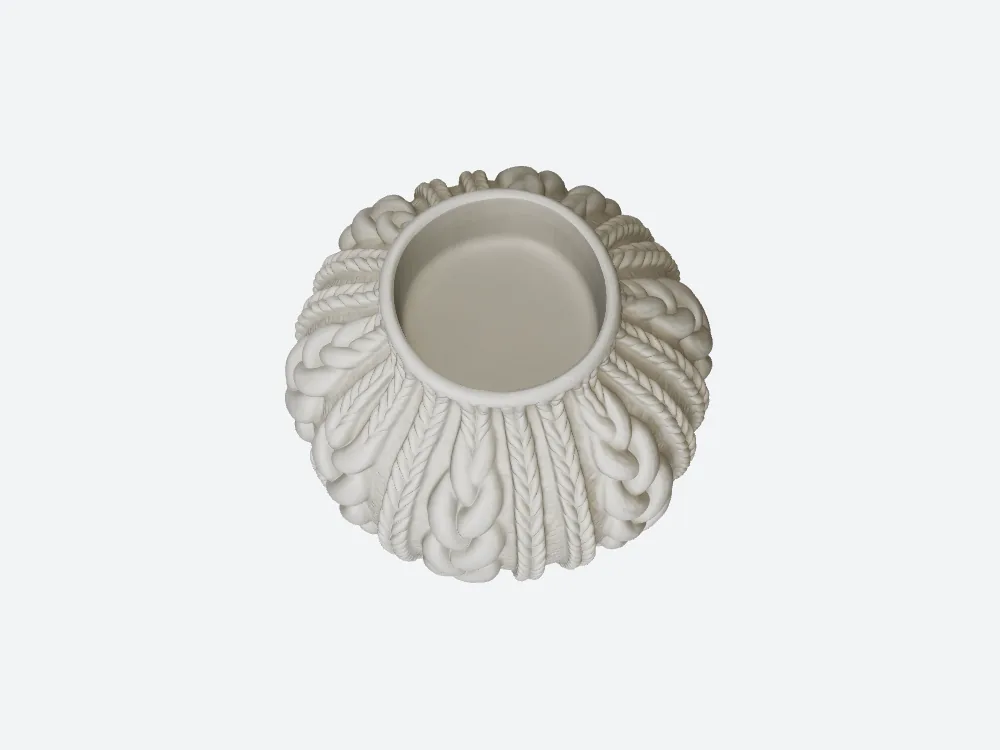
SupaVoxel also has an open mouth and an interior floor. This is not a tested water-holding container.
No. At the same 120 mm longest-side scale, the SupaVoxel body is 120 mm tall and its inner loop first appears between 80% and 81% of height. That brackets the modeled cavity at 22.8–24.0 mm, approximately 9–12 mm shallower than Hyper3D's bracket. More spectacular exterior knit did not buy a deeper vessel. Both models are mostly solid below their rims. These values are from mesh sections, not a water-volume or leak test. SupaVoxel's non-manifold geometry makes treating any signed volume as a trustworthy resin bill worse still. For a functional vase, both would need redesign: a wider/deeper interior, validated wall thickness, repairs and real testing.
What does solid resin arithmetic permit here?
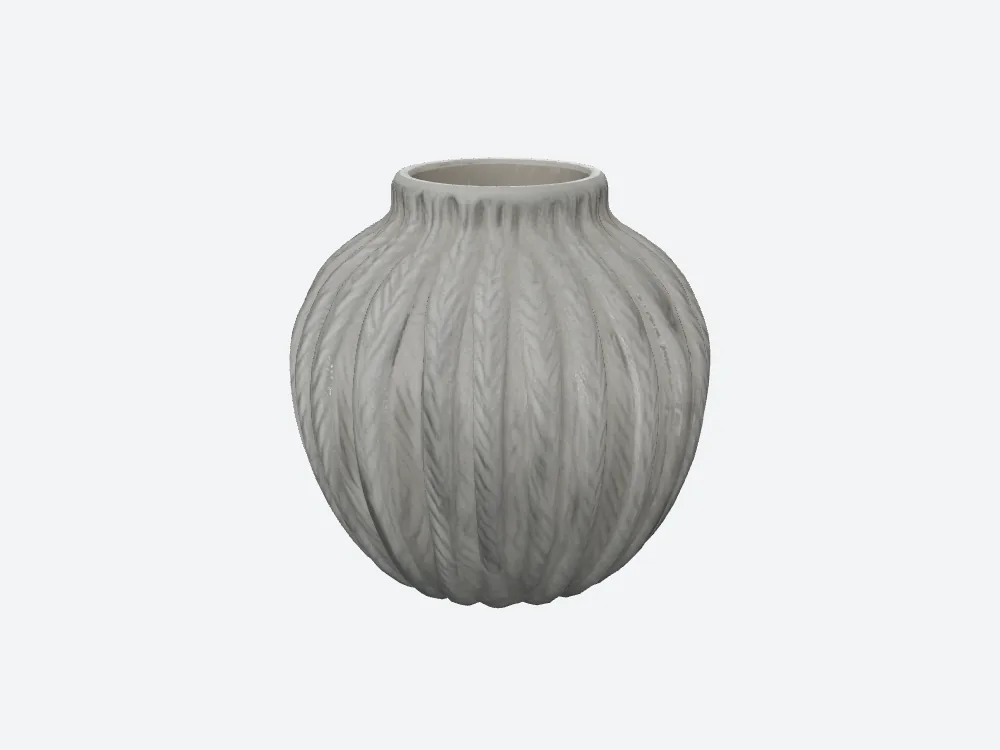
Hyper3D's closed starting mesh allows conditional solid-fill volume arithmetic; its image still says nothing about liquid tightness.
Only the Hyper3D welded body passed the closed-solid checks needed for this estimate. At 120 mm maximum outer dimension, it computes to 817.04 cm³ of modeled solid; at a hypothetical $35 per liter standard resin, $28.60 before supports, waste, hollowing, washing or failed prints. That is not the cost of a successful vase. SupaVoxel has no validated solid-fill resin estimate in this case because its welded mesh is not watertight and carries non-manifold edges. I won't recycle a signed-triangle volume from an invalid solid and call it a bill. A real workshop would repair, revalidate, slice and only then estimate consumption for both, after choosing a functional cavity design.
Does “potential overhang” predict actual support?
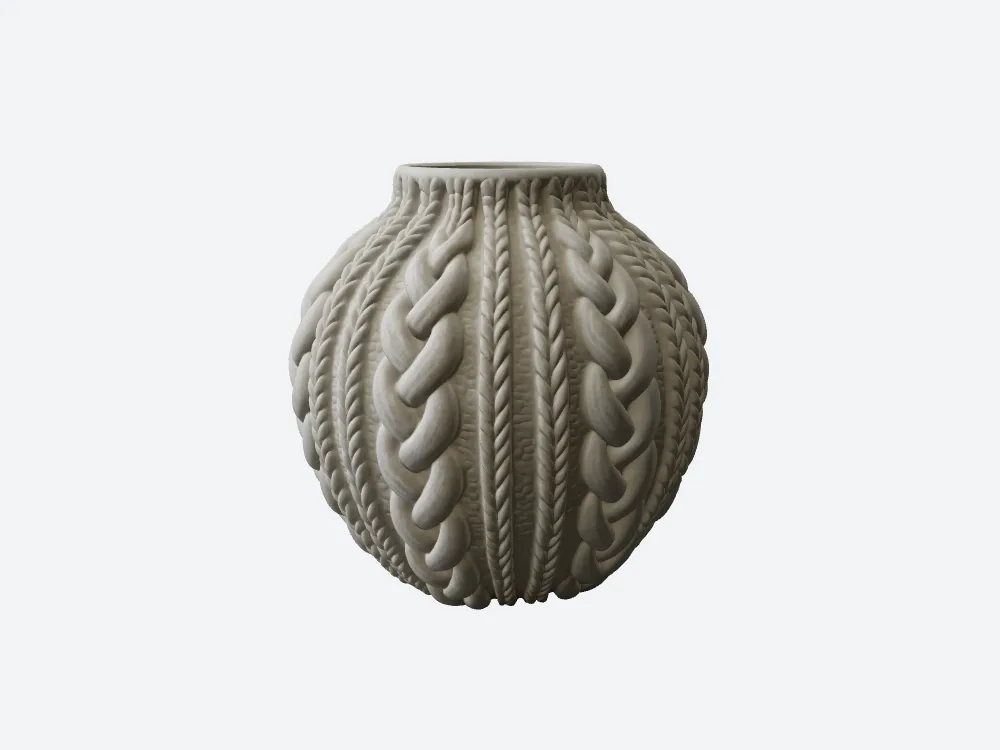
The side view shows knit relief; it does not reveal actual slicer-generated support material.
With Y-up and normals within 45° of straight down, Hyper3D has 4,655.3 mm² (8.32%) of potentially downward-facing area and SupaVoxel 5,704.4 mm² (8.88%) at the same normalized largest dimension. That's 1,049.1 mm² more for SupaVoxel in this particular orientation. It does not mean 1,049.1 mm² more supports: bottom faces against the platform can count, orientation can change, and slicers use additional rules. This one normal-based measure favors Hyper3D, but implies no measured labor saving. If I rotate either vase or hollow its body, I would rerun the calculation instead of reusing this figure.
Does Hyper3D win every triangle-quality test?
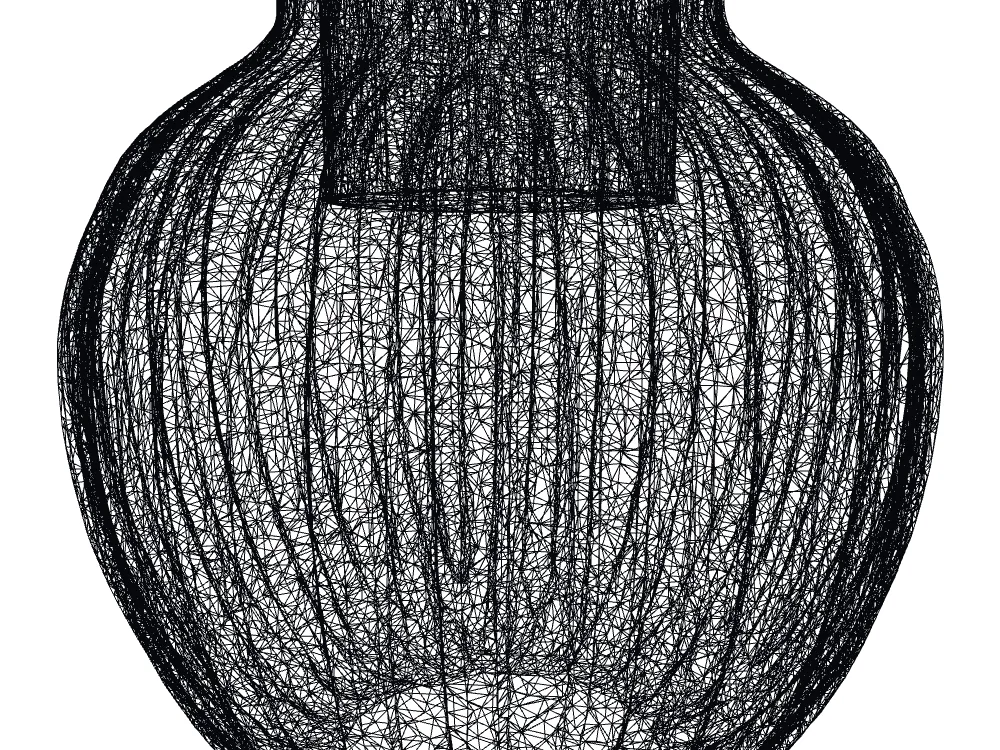
The sparse Hyper3D wireframe is legible; its slender-face count is a separate measured file statistic.
No. Both files had zero degenerate faces under the common threshold, but Hyper3D had 1,416 slender triangles where SupaVoxel had 17. SupaVoxel wins that narrow hygiene row by 1,399 fewer slivers, despite losing the non-manifold and connected-shell rows. At the 120 mm scale their mean triangle edges are 1.5679 mm and 0.4410 mm. A 0.4 mm FDM nozzle offers context, not a guarantee that either strand is printable; mean edge length is not local groove width. You cannot hide Hyper3D's slivers behind its “watertight” label, just as you cannot hide SupaVoxel's 744 non-manifold edges behind attractive knit relief.
Was the better Hyper3D preview actually downloadable?
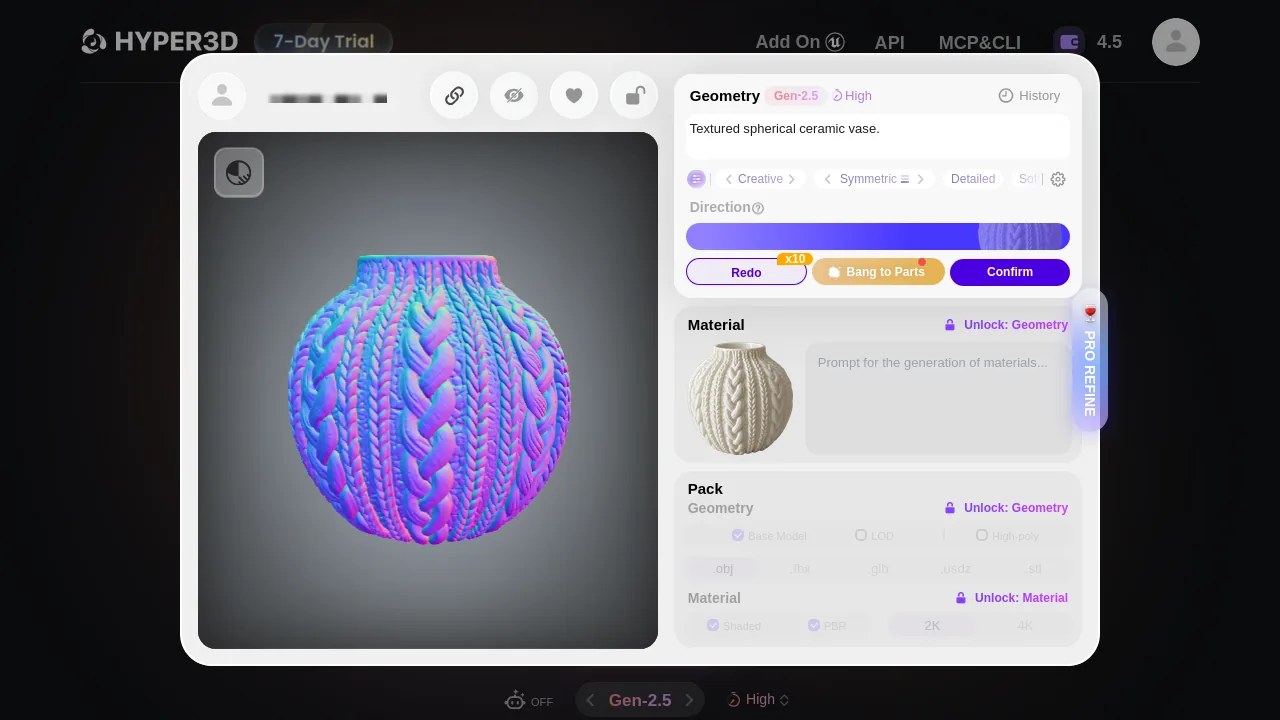
The Gen-2.5 screen shows larger crossings and a million reported faces; it supplied no audited GLB to this Free user.
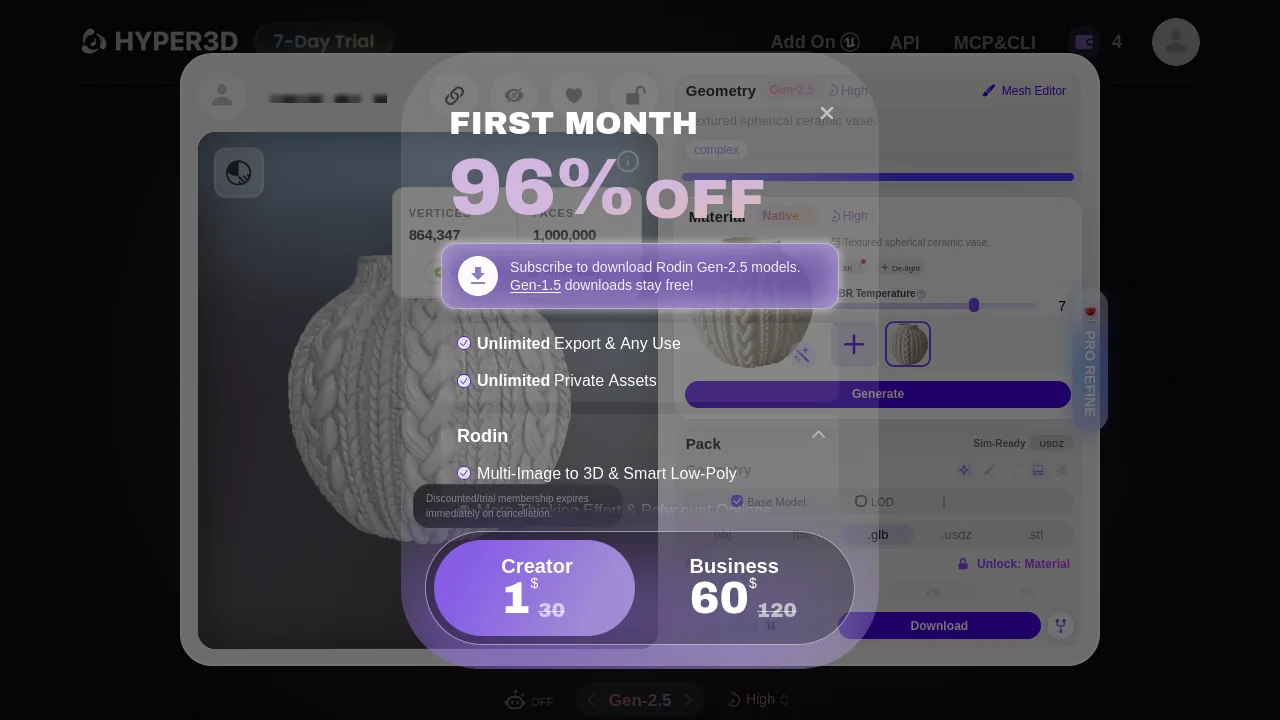
Download on that confirmed Gen-2.5 task asked for a subscription and said Gen-1.5 downloads remain free.
The Gen-2.5 preview looked closer to the source than the Gen-1.5 model I took home. I would have liked to test its weave and topology. After confirmation the UI displayed 1,000,000 faces; the Free account could select GLB but not download it. Gen-2.5's automatic caption also differed from Gen-1.5's, omitting “knitted,” so I cannot assign their visual difference to version or triangle count alone. No Gen-2.5 file was measured; no claim about its watertightness, cavity or price of a downloadable PBR is warranted. A gated preview is a useful purchase illustration, not evidence for the file comparison on this page.
Final verdict: which problem would I rather repair?
For a first physical-prototype starting mesh, I favor the downloadable Hyper3D Gen-1.5 file's closed, single-shell topology and slightly deeper modeled recess. That is not an endorsement of it as a functioning vase. It largely misses the reference's defining cable crossings and has 1,416 slender faces. SupaVoxel nails the large geometric knit but its 497 face-edge regions and 744 non-manifold edges need repair before a solid-print claim, and its recess is only 22.8–24.0 mm deep. If the work is a digital relief study rather than a print, I choose SupaVoxel; if I need an untouched, cleaner starting shell, I choose Hyper3D. Waterholding remains untested for both.
Use SupaVoxel when the design brief is knit geometry
For a concept sculpt in which raised strands must remain when textures are hidden, SupaVoxel gave me the closer geometric starting point. I would repair its junctions and retest the corrected file before slicing; I would also redesign the shallow interior before calling it a flower vase. Hyper3D Gen-1.5 is my alternative for a simpler already-closed ribbed body. Neither recommendation substitutes for a print, leak test or vase-stability measurement.
How I tested and what remains open
Both files came from the same SHA-checked PNG. I compared actual exported Hyper3D Gen-1.5 PBR and SupaVoxel Original size GLBs, not the locked Gen-2.5 preview. Matched offline cameras, clay renders and Y-up horizontal sections were used; the sections bracket interior loops, not precise CAD measurements. UV-seam vertices were welded before topology checks. All 120 mm figures use the longest bounding-box side, which gives Hyper3D only 117.11 mm of vertical height. The downward-area rule and resin-dollar figure are arithmetic under explicit assumptions; neither measures printed supports or a watertight physical vessel. No Fix Mesh operation, slicer, print, fill or stem-stability test was performed.
Originally published on Medium: Hyper3D Vase Review 2026: A Watertight Shell, but No Big Cable Crossings.